
Building on a recent research project, Georgia Bulis-Gray explores how art can contribute to new understandings of our attitudes towards nonhuman beings.
Contested History of Animal Ethics
In the midst of current unprecedented global challenges, it’s important we reassess our duties to other living beings. However, understanding the relationship between humans and nonhuman animals is tricky, because it has never actually been clearly defined.
Philosophical accounts throughout history have seen nonhuman animals considered ‘beasts to be controlled’, had them dismissed as ‘automatons’ – and they have even been viewed symbolically as representatives of virtuous or vicious character.
Animal ethics – which considers such philosophical relationships – draws together knowledge from the natural and social sciences to ask important questions about our everyday entangled reality.
But introducing art into this investigation can offer a different perspective on the way our ethical attitudes towards nonhumans have grown and changed over time.
Art leaves a trace – of both what humans think, and how they really act.
Art as a window into philosophy
In sociological studies, ‘social practices’ are routines or sets of behaviour developed over time, and they influence the attitudes and actions of their participants.
An example might be the social practice of childcare. One routine might be that adults undertake the responsibility of caring for children – whilst the meaning of ‘care’ within this practice is defined and built upon by the participants over time.

Here, we see both the ideological and material nature of ethics at work, and how these parts interact to influence real world actions in each of us.
Traditionally, nonhuman animals haven’t been considered as participants in social practices, although they are significantly impacted by them. Practices shape human attitudes and actions within human-animal relationships.
Drawing on the discipline of art can help shed light on how these dynamics develop, how they’re challenged and how they are reproduced across different social practices.
In doing so, we can anchor what can be seen in art to real-life patterns of human action, and emphasise the evolving nature of the human-animal relationship across time.
So what does this look like in practice? Here are two examples, sparked by revisionist analysis of two artworks from The Hunterian’s collection.
Family Life and the Animal
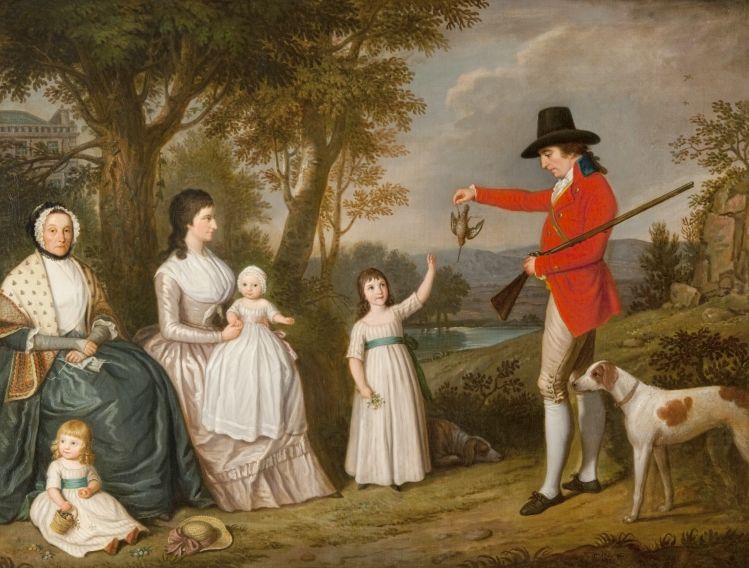
This first artwork demonstrates the co-existence of several, contradictory multi-species social practices. It uncovers a historical precedent which continues to this day.
The Spreull Family (1792-1794) by David Allan is an example of a conversation piece – a popular 17th and 18th century style of group portraiture aiming to depict family groups engaged in typical activities.1
Reflecting on the goals of this genre, the inclusion of nonhumans in such paintings shows that social practices of family life in this era, and the social context, involved human-animal relationships.

This observation in itself challenges the narrative of purely domination-led human-animal interaction. It’s also still true today that most people assume higher levels of ethical responsibility and care towards animals arbitrarily defined as ‘domesticated’ or ‘pets’.
The confusing ethical experience of human participants as they relate to nonhumans differently in varying types of cross-species interaction is a central theme of this painting.
Defining ‘Dogs’ and Symbolic Birds
The dog lying at the back of the image is literally and symbolically connected to the human family. Like the family members to the left of the painting, it is passive. It is also seated and very much relaxed within the family group.
Through the repeated inclusion of the dog in real family activities, it becomes conceptually linked to the family – and not necessarily defined by the typical norms of human-animal interaction.
The meaning of ‘dog’ is conceptually elevated to family member in the social practices of family life.
The other dog is clearly visually connected to James Shortridge (Spreull), returning from shooting a bird. This dog is standing, active, and bares a stern, solemn expression – which is similar to Spreull’s own.
This suggests that within the social practice of hunting, the concept of the ‘dog’ holds different meaning. It occupies a distinct conceptual position in relation to humans. The dog is viewed and treated as as distinctively wild, animal tool within this context.
The bird, the compositional focus of this piece, represents an animal which is excluded from the social practices of family life – but which is regarded as a resource within the practice of hunting.
It’s symbolically and ideologically the excluded ‘other’ around which the humans in the image build their identities.
The Spreull Family represents a window into the complex evolution of diverse and contradictory attitudes towards nonhuman animals in distinct but co-existing social practice contexts.
The Criminal Connection: Human and Nonhuman Bodies
The second example looks at the creation of art as a social practice itself, and highlights the development of inter-species relationships over time.
Michael Henry Spang’s Anatomical Figure (1760-61) is a miniaturised bronze version of a cast of a flayed criminal’s body. Écorché figures (skinless anatomical models) such as this came to be commonly used to aid anatomical learning during the early modern period.
The history of anatomical investigation is one which crosses species boundaries. In the early modern era, the only legally and ethically acceptable subjects for anatomical study (as with Spang’s écorché) were human criminals and nonhuman animals.

The norms established within the social practices of anatomical study and criminal punishment of that time draw a clear ethical equivalency between what was deemed a lower class of human moral subject (the criminal) and the nonhuman animal.
Artworks, such as this piece, were enabled only through the repeated and accepted designation of certain animal bodies as ethically insignificant.
In death, human criminals and nonhuman animals were both transformed into anatomical objects such as écorchés. In life, both groups were also unwilling participants in the social practice of criminal punishment, which similarly influenced the evolving human-animal ethical relationship.
Humanising animals and animalising humans
Animal historians of the early modern period note that in some legal cases involving bear attacks in 18th century England, retribution for the offence fell on the bear rather than the human owner.
In this way, the punishment of bear baiting transformed into something like a quasi-criminal animal trial, similar to human executions.2

More than merely the loss of an asset to the human owner, such executions were framed as acts of justice. This is philosophically interesting, since the successful public reception of such a practice implies that bears were seen to be deserving of their fate.
A creature must be included in a community to be subject to its ethical rules. This criminal practice solidifies these bears’ status as moral agents, conceptually aligned to humans.
Through the developing norms of behaviour in the social practice of criminal punishment, the bodies of humans and nonhumans become conceptually connected.

Nonhumans are partially humanised in order to be rendered deserving of criminal treatment – whereas human criminals are animalised by being treated as bodies fit for dissection.
Using artworks as artefacts of historical social practices helps to bring these complex philosophical developments and their ethical implications to the fore.
Our relationship with nonhuman animals and our perceived duty, or lack of duty, towards them is not a fact set in stone. These ideas are put in place by humans, and can be changed by us, as we live our lives alongside nonhuman others.
By summarising a few key aspects of my findings here, I hope to invite museum and gallery visitors to experiment with looking at The Hunterian’s collections in a new way – as evidence of, and in inspiration for, societal ethical changes at the micro-scale of everyday social practices.
Further Learning
Interested in animal ethics? The Hunterian Zoology Museum implemented an important intervention into their displays in 2023, using extinction crisis labelling around the museum space to highlight holdings related to species facing extinction.
Georgia Bulis-Gray’s full research, Animals in the Gallery: a Case Study of Social Practice-Led Art Analysis, is in the process of being developed into a paper for publication.
Further Reading
Animal ethics and art – see ‘Art Education Beyond Anthropocentricism’ by Mira Kallio-Tavin, Art, Ethics and the Human-Animal Relationship by Linda Johnson, The Ecological Eye: Assembling an Ecocritical Art History by Andrew Patrizio.
Social practices and environmental philosophy – see Anarchisms, Postanarchisms, and Ethics by Benjamin Franks, Justice for Animals: Our Collective Responsibility by Martha Nussbaum.
The bibliography for this blog post is available to download.
There are more brilliant blogs stretching right across our collection for you to explore – covering coins, medals and much more!
1 Kate Retford, The Conversation Piece: Making Modern Art in Eighteenth Century Britain (New Haven, CT: Yale University Press, 2017), p. 54.
2 Erica Fudge, Two Ethics: Killing Animals in the Past and the Present, Draft p. 28 (appeared as ‘Two Ethics: Killing Animals in the Past and the Present’ in Killing Animals, The Animal Studies Group ed. (University of Illinois Press: Urbana and Chicago), pp.99-119).
