
On the 200th anniversary of the birth of William Thomson, Lord Kelvin, curator of scientific and medical history collections, Nicky Reeves, reflects on broken things in The Hunterian’s collections.
In one of the labels that accompanies The Hunterian’s current Curating Discomfort intervention, my colleague Zandra Yeaman emphasises the importance of remembering.
“Museums hold collections that enable us not to forget, but to remember”, she notes.
Accessing, recalling and interpreting can be practices of holding things and people to account. Remembering in this sense can be the opposite of forgetting, but remembering can also be the opposite of dismembering.
As vegan theorist Carol Adams points out, to re-member is to try to put back together that which has been separated, butchered, fragmented, objectified, or reduced to a series of parts or representations.


Labels from the ‘Curating Discomfort’ intervention at the Hunterian Museum. Click to enlarge each image.
Remembering in this sense, genuinely making things whole again, is simply often not possible. Fragmentation of, for instance, human remains, is a process that turns human bodies into specimens that cannot necessarily be made whole again.
It’s notable how swiftly some museums, having only quite recently recognised certain deep systemic silences and structures, are confident that it is museum professionals who are the ones who are going to solve the problems, or that museums, often the beneficiaries of, for instance, colonialism, are the institutions best placed to correct the devastation of colonialism.
In their quest for justice and perhaps redemption, museums sometimes ironically continue to fragment the already fragmented. We see this in the strong urge to analyse, scrape, sample, and to extract DNA that is often coupled with the positivist belief that more knowledge will lead to more justice.
Venerable museum utopias, such as what historian of heritage practices Christina Riggs calls “the totalising quest for completeness“, persist at the exact same time that such utopias are being acknowledged as having been at best hubristic, more likely dystopian and sometimes hugely destructive.
Elsewhere in Curating Discomfort our colleague Churnjeet Mahn from the University of Strathclyde queries whether things can indeed be made good.
Responding to a species of lizard made extinct by exploitative colonial practices in Jamaica, she notes that “here we can see how colonialism contributed to the devastation of ecosystems that cannot be repaired, and for which there is no restitution”.
Maybe there is no restitution, and maybe museums are not necessarily going to be able to bring about equity or justice, and maybe we need to simply sit with the disquiet.
Museums make relics
The collection and conservation of many different types of fragments is of course an unremarkable yet fundamental aspect of museum work. Archaeological collections, for instance, are usually constituted by the incomplete, the broken, the fragmentary, the sherd.

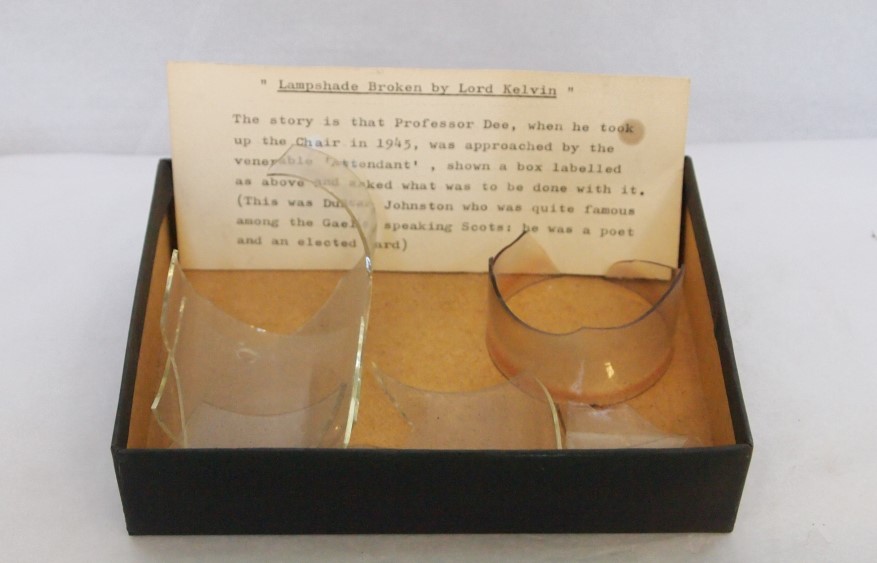
Another type of fragment found in museums and other places is the relic. GLAHM:151914 is a lampshade allegedly broken by William Thomson, Lord Kelvin, born 200 years ago last month. Relics routinely have causal powers: through their supposed purity and authenticity they are a direct link back to an originary thing or holy person, and through encounter or touch they effect influence.
The more implausible the causal chain, and the more fragmentary the relic, the more mystique and power they have. Museums don’t just collect relics, however: they make them and maintain them.
Consider the function of the now-itself-quite-old typewritten card label contained in the box with the bits of broken glass. It’s interesting that the label is a story, albeit an incomplete story. It gains credence not necessarily from whether or not it is true, but by being told, and by being repeated. Repetition is an important form of memorialisation.
Lampshade breaking did not lead to any interesting breakthrough in the understanding of electromagnetism and the propagation of light, conductive and insulating materials, the maintenance of universal standards and their precision measurement, or the tensile properties of glass: it’s just a broken lampshade.
Re-memberance in this instance, namely sticking the bits of glass back together to create a lampshade, might go some way to deconsecrating the relic, most of all by returning it to being merely a very quotidian lampshade.
We could, alternatively, decouple object from label, decouple object from mythology, and we would be left with merely some bits of broken glass. I care about these fragments of glass because as memorials they imply a type of hero worship which is unhelpful and un-progressive. They are not harmless, and we have limited resources.
A place for the broken
Scientific instruments made, used or designed by Lord Kelvin are displayed or stored by The Hunterian. Measuring devices (electrometers, voltmeters, ammeters), navigational devices (precision ship’s compasses, sextants and octants, for instance), communication devices (transatlantic cables, for instance): all of these required global networks, and all of them made global networks possible.
However, a central issue to be addressed with respect to interrogating the legacy of empire in a collection of instruments, devices and machines is to note that museums sometimes both overstate the strengths of colonial practice and overstate the strengths of scientific practice.
If colonial — and/or capitalist — projects were to subdue, commodify or dehumanise then it doesn’t mean they worked. As many historians have shown, resistance and agency can sometimes be missed or minimised if we take the colonialists’ account or historical claims too literally.
Unpacking the rhetorical claims of universality and progress in the sciences might have some overlaps and parallels to unpacking rhetorical claims made on behalf of colonial projects.
The material holdings of the museum in their materiality offer some resistance or recalcitrance: their messiness and their role as – admittedly, as discussed above, always incomplete – evidence can helpfully undermine rhetoric by pointing to reality, theory by pointing to practice. Broken scientific instruments are present in collections: breakages tell something of the lives of objects.

GLAHM:105022 is one of several quadrant electrometers based on designs by Lord Kelvin. This is a measuring device, it measures potential (voltage), in atmospheres, in batteries and conductors, and can help determine precision measurements of resistance in cable materials.
Numerous developments to this sort of device were made by Kelvin and his business collaborators over several decades. Like with a large number of electrical devices in The Hunterian’s collection pertaining to Kelvin, the principal requirement is very reliable, very precise measurement.
Everything else flows from this desire for very finely tuned measuring instruments capable of replicating conditions exactly, repeatedly and globally. Any kind of system of standardisation of communication, measurement, voltage, transformation, requires this replicable exactitude, and requires the potential mass production and transportation of measuring devices and the standards with which they are calibrated.
The electrometer’s jar is broken: the glass has smashed, its ability to measure or replicate undone. There are items in The Hunterian collection which have been broken through bad curatorial handling, and this tells us something important about the museum’s conceit about being trusted custodian of culture and history, but this is, most probably, not that sort of breakage.
It’s a much more interesting breakage that shows use, and shows the limitations of materials, and shows that theory has its limitations when it comes up against practice: things don’t always work, things explode.
Often when complete examples of this sort of brass and glass instrument are displayed, it is as if they are equivalent to diagrams, perfect and pristine. The display of the non-pristine, the faulty, the broken, the error: this is another way in which fragments in museums can have meaning and uses after all.
What would a Hunterian exhibition of lots of broken stuff look like, and what new ways of memorialising people like Kelvin might it prompt?
There are more brilliant blogs stretching right across our collection for you to enjoy – covering art, coins, medals and much more!

One response to “Fragments, relics and remembering”
[…] and Medical Collections at the Hunterian in Glasgow) has just written an excellent blog post on ‘Fragments, relics and remembering’. Amongst other things, he stresses […]