
Over the last few decades, the Davidson family has generously gifted The Hunterian a significant portion of its collection. These works are by late 19th and early 20th century Scottish artists.
The collection was originally built by William Davidson (1861-1945) and his wife, Jean Steel Reid (1866-1945). It counted over 80 framed paintings and works on paper.
Their granddaughters, Winifred and Margaret, have left over 40 paintings and drawings of this collection to The Hunterian.
Here, we explore the artists in the collection known as the ‘Glasgow Boys and Girls’ and highlight some of their pioneering artwork.
The Glasgow Boys and the Davidson Collection
Works by the Mackintoshes and John Quinton Pringle count for roughly half of the Davidsons’ granddaughters’ gifts and bequests. The other half is dominated by ‘The Glasgow Boys’.
This group of influential artists were working in Glasgow in the late 19th century. Like other European and American avant-garde artists, they had a consuming interest in the mastering of light and colour.
At first, the group’s work would explore Realism and Naturalism as developed by French and Dutch artists.
However, by the late 1880s, the Glasgow Boys were moving towards a more decorative approach. They began weaving their colours and brushwork in a manner almost flirting with abstract effects at times.
Like artists such as John Quinton Pringle, William Somerville Shanks and Charles Rennie Mackintosh, the Glasgow Boys were also seen as pioneering artists by their contemporaries.
In his introduction to David Martin’s book, The Glasgow School of painting (1897) Francis H. Newbery stated:
“They […] have a firm belief in one thing – which is, that it is quite sufficient for Art to be Art, and to be the most beautiful thing that the hand of man is capable of making of her.”
A statement William Davidson would have wholeheartedly embraced.

By the early 1900s, the ‘Boys’ – as they were affectionally known – gained an international reputation in Europe and America.
Davidson must have followed their progress with interest. He had at home catalogues of exhibitions in Munich (1890) and Chicago (1906). This is where they were exhibiting their work to great acclaim. These catalogues are now in the University of Glasgow Archive and Special Collections department as part of the Davidson archive.
Highlights include works by Edward Atkinson Hornel, George Henry, Harrington Mann and Bessie MacNicol. They all add to the story of the Glasgow Boys and Girls as seen through The Hunterian’s existing holdings.
George Henry
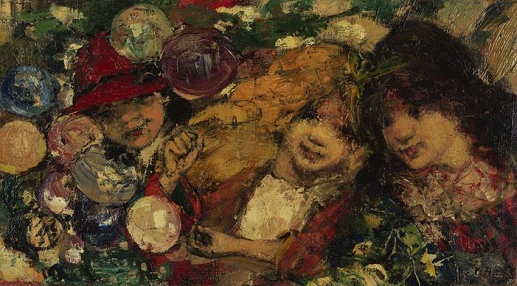
The following painting illustrates the Glasgow Boys’ contemporary interest in decorative and symbolic female figures in woodland or garden settings. It’s possible the purchase was from Alex Reid and Lefevre in February 1928 with the title In the backyard.

Together with his friend Hornel, “animated by a […] vital and sincere delight in color and by […] a mastery of potent and intoxicating harmonies” (James Caw, Scottish Painting 1620-1908, published 1908), Henry was considered by his contemporaries as among the most prominent of the Glasgow Boys. Davidson owned three works by the artist at some point.
In Three girls in a cottage rose garden, bold marks and blocks of colour define form. They create a decorative surface pattern in which the evidence of the artist’s manipulation of the paint surface is an important element.
Painted in full sunlight, it represents the natural development of Henry’s concern for colour and form since works such as The Hedge Cutter.

This painting was from five years earlier. At that point, the Boys’ realist interest in issues of labour, leisure and modern life was starting to attract the attention of the European art scene.
It is one of two works by Henry now in The Hunterian collection, which came from the Davidson collection. The other was Girl with Red Hair (GLAHA:58215).

Both capture that transitory moment in the career of the Boys. They began moving away from Naturalism towards a more symbolic, decorative approach. This was something that obviously appealed to the Davidsons.
Together, they add context to works by Henry that were already in The Hunterian collection. This includes Sundown, which captures Henry’s essay in nocturnes inspired by the American artist James McNeill Whistler. It marks the beginning of the artist’s experiments with the approach mentioned above.

Edward Atkinson Hornel
Very close to Henry – the two artists often painted the same subjects together and occasionally collaborated on paintings in the 1890s – Edward Atkinson Hornel was a favourite with Davidson. At one point, the Davidson collection included 14 works by the artist.
Three of them are now in The Hunterian collection: Romance of Japan (GLAHA:58231), Autumn (GLAHA:51983) and Three Children with Balloons (GLAHA:58228).

What attracted Davidson to Hornel’s work must have been, as the Chicago Institute of Art exhibition catalogue for 1908 from Davidson’s archives describes, that:
“He did not – and does not – work from the standpoint of the conventional painter of pictures, but rather from that of the weaver of rugs, the designer of jewelled glass or mosaics. Beauty of colour and its infinite combinations is the chief aim of his expression.”
Davidson’s paintings all date from the second half of the 1890s. This was when Hornel, buoyed up by the success of his 1893 trip to Japan in the company of Henry, was trying to find a way forward from his Japanese subjects in inventive and innovative ways. He would play with different structures and paint application.
Autumn, picturing two girls in a wood, is typical of that period. Young girls in woodland glades – possibly woodland spirits – associated with an allegory of the seasons, were a popular subject matter among European painters, the Glasgow Boys included, from the mid-1880s onwards.
Hornel alone painted at least three paintings titled Autumn between 1888 and 1904, centred around such a theme.

The small painting is contemporary with the artist’s contribution to The Book of Autumn (1896), the second issue of The Evergreen, a short-lived journal showcasing the Scottish Celtic Revival Movement ideas and aesthetics.
With its textured brushwork and impenetrable surface, its figures merge with autumnal woodland. The naturalism eschewed, it takes Hornel’s fascination with an enclosed subject and fusion of figures and background – initially explored in his first version of Autumn dated 1888 – as far as it can go before reaching abstraction.
It fills an important gap in The Hunterian representation of Hornel.
Harrington Mann
Tilted ‘Quayside’ when it entered The Hunterian collection, this view of Venice is notable for its strong sense of design and colour. For Davidson, who purchased the painting in 1921 from Wylie & Lochhead Limited, this was always a winning combination it seems.
Like many of the other artists represented in Davidson’s collection, Harrington Mann was among the talented students who went through Glasgow School of Art in the late 1880s and early 1890s.

Associated with the Glasgow Boys in his early career, he went on to study at the Slade School of Art in London. From here, he won a travelling scholarship to Italy (1887-1889), before entering the Académie Julian in Paris.
Upon his return to Glasgow, he worked as a designer for JW Guthrie (now Guthrie and Wells) during the 1890s. Here, his work included producing designs for stained glass windows and murals. He also drew illustrations for the Daily Graphic and the Scottish Art Review.
These years saw him returning to Italy several times. He would experiment with a bold use of colour, light, and brushwork, allied with a strong sense of design.
The Pier at the Custom House, Venice highlights the artist’s versatility, and willingness to try his hand at different approaches.
It differs markedly from most of his other works at this time. It highlights his affinities with the Glasgow Boys’ contemporary take on landscapes painted in foreign lands, from Italy to North Africa.
This also hints at his admiration for painters such as James McNeill Whistler. In some ways, this work anticipates the direction avant-garde landscape painters from the next generation would take in the early 20th century.
The approach took on bold colours, a freer brush, and an exploration of modulations of light, shade and atmospheric effects.
Bessie MacNicol
Associated with the younger members of the Glasgow Boys, MacNicol is another contemporary student of the Macdonald sisters and Mackintosh at the Glasgow School of Art, where she studied between 1887 and 1892.
Encouraged by director Francis H. Newbery to pursue her studies in Paris, she spent time at the Academy Colarossi. In 1896, MacNicol worked alongside Hornel and friends at the artist’s colony in Kirkcudbright, Dumfries and Galloway.
Upon her death in childbirth, her promising career came to an end at the age of 34. There is widespread acknowledgement that she was among the most talented artists from Scotland at the turn of the century.
Elegantly dressed young women, whose outfits could reflect the past or the latest fashion, and light itself, were among her favourite subjects.
MacNicol’s grandfather was a master tailor. He probably played a part in her interest in the textures and shapes associated with fashion.
In 1898, MacNicol saw the comic play by Arthur Wing Pinero, “Trelawny of the Wells”. It tells the story of a theatre star from the 1860s. They attempt to give up the stage for love but are unable to fit into conventional society.

Its costume and production design, perfectly recapturing the fashions of the period, enchanted MacNicol and others. The Lace Cuff, dates from that very year, and is among several works from the last two years of the 19th century that may well have taken inspiration from the play’s costumes.
It has joined another work by MacNicol, already in The Hunterian collection, called ‘Lamplight’. Its inclusion brings the number of works by the artist in British public collections to a heady 14.

Together, these works play an important role in helping to understand the versatility of a talented artist. She was among the very few women artists acknowledged as equal to their male colleagues by contemporaries.
The Davidson family have been integral to the development of The Hunterian representation of Scottish art over the last 100 years.
Margaret and Winifred’s bequests are a tangible reminder of William, Jean and their family’s support to many early 20th century Scottish artists.
While highlighting the achievements of these artists, they also provide a glimpse into one of the most interesting collections gathered by a Glasgow collector in the early decades of the 1900s.
For more on the different artwork in the Davidson collection – from works by the Mackintoshes and more – explore The Hunterian blog!

3 responses to “The Glasgow Boys and Girls”
[…] Art Gallery displays several artworks by women artists such as Margaret Macdonald Mackintosh, Bessie MacNicol and Alison […]
[…] most famous artist groups to come from the British Art Nouveau era was the Glasgow Boys and the Glasgow Girls. The Hunterian collection has an extensive array of works from these two iconic Scottish […]
[…] Mackintosh, a group known as the Glasgow Boys brought a fresh perspective to painting. Active in the 1880s and 1890s, these artists, including […]