
We join Struan from our Visitor Experience team for a virtual tour through our collections – with a focus on Scots language, history and folklore!
Here at The Hunterian, I’ve been very fortunate to have had support for a project I proposed which encourages the use of Scots language in our galleries and displays.
This has been a gradual process, but one which enjoys continued support. It includes my writing of a translation into Scots of our guide to the Mackintosh House, as well as working with fabulous poets such as Len Pennie and Alan Riach to organise a Scots poetry evening in the Art Gallery.
Going forward, I want to engage more widely with the objects we have in our collections and on display. The following takes inspiration from the fact that students, scholars and visitors come from all over the world to visit, study, and work in Glasgow and at the University.
We find that they’re always eager to learn something about Scotland and its culture during their visits.
To celebrate St Andrew’s Day, let’s explore some Scottish culture and language through the medium of our collection – using objects to make connections with some of our traditions, folklore, and linguistic features…
Magpies
The birds of the genus Pica Pica are called magpies in English, but in Scots they can also be called a pyat, pianet or piyot (with lots more variations). These words are not exclusively for magpies but can refer to any bird with ‘pied’ plumage. That is, with large unpigmented sections against a pigmented background.

In Scottish tradition, magpies were often birds of ill omen and bad luck, who were said to carry a drop of the devil’s blood underneath their tongues. A single magpie appearing at a window might be interpreted as an ill omen, but you could also use magpies as a means of prophecy – such as by using rhymes like the one that’s most common today:
One for sorrow,
Two for joy,
Three for a girl,
Four for a boy,
Five for silver,
Six for gold,
Seven for a secret,
Never to be told.
Bumblebees
In Scots, the Bumblebee can also be called a bum-bee, or a humble-bee, depending on which you like best. In Scottish folklore, as in many other European countries, there was a long tradition of ‘telling the bees’ about important events, births, deaths and marriages.
If you didn’t, the bees might abandon the hive itself. This is speculated to possibly derive from very ancient beliefs of bees acting as messengers between this life and next, although nothing is truly certain.
Even when Queen Elizabeth II died in 2022, the royal beekeeper at Buckingham Palace made sure to inform the bees in the royal hives and asked them to stay.

Wolves
The inspiration for this one actually came from the Dire Wolf skeleton on display in the Hunterian Museum – a species which was common in North America in the Pleistocene period which lasted from 1.8 million to 11,500 years ago.
Wolves were once very common in Scotland, and you can see them represented on maps of the kingdom in the Middle Ages. In early societies, the wolf might be respected for its hunting prowess and strong familial bonds.
However, as human habitation expanded, and humans came into greater conflict with wolves, they were increasingly perceived and portrayed as dangerous creatures that preyed on livestock and unwary humans alike. The latter is probably exceptionally rare.
Over time, wolf numbers in Scotland declined to the point of extinction – thanks in part to rewards being offered for their killing, and by a decrease in their habitats. According to legend, the last wolf in Scotland was killed in 1743, but such precise dating seems doubtful.
Capercaillie
The capercaillie, also known in Scots as the capperkailzie, caperkylie or caper coille, draws its name from the Scots Gaelic capall coille, which translates literally to “horse of the woods”.
In a variation of the Scots spelling using the letter Z – e.g. capperkailzie – you don’t pronounce the letter “Zzz” but rather with a “Y” sound. This is because in some Scots words Z stands in for a “Yogh” – ⟨𝔷⟩ – , which is a letter we don’t use any more, which either had a “Y” sound, or could be silent in a word. You can see this in names like Menzies, which is traditionally pronounced like “Ming-is”.


Although the Capercaillie became extinct in Scotland in the 18th century, due to hunting and loss of its habitat, it was reintroduced from Scandinavia and has managed to survive thanks to new protections for it and the woodlands it calls home, although it remains in a precarious state.
Hen Harrier
In Scots, the Hen Harrier are also known as the Mitten or as the Katabella, reportedly named after how much their plumage resembles a cat. You can see a similar naming convention with the name kattul, or cat-owl, which is a term which could refer to owls in general, but with particular reference to owls with tabby plumage.

Butterflies
A lot of Scottish folklore is based around luck, or ways to mitigate bad luck. Butterflies in Scottish folklore were, much like magpies, used as creatures of omen able to give an indication of what the future held when they appeared.
White or yellow butterflies were thought to bring good luck, while red or crimson butterflies, along with some others, were associated with witches. A golden butterfly near a grave was considered a positive sign; that the grave’s occupant had ended up somewhere good.

Seals and Selkies
The geography of Scotland is dominated by the relationship between water and dry land. Scotland is a nation of islands, forming the topmost part of the main island of Great Britain, with hundreds of smaller islands all along its coast. Its lochs, mosses, rivers, weirs and waterways ensure that, no matter where you are, you’re always near some form of water.
Few animals can embody this relationship between land and water better than the seal. Scotland is home to one of the largest seal populations in Europe, comprised of two main species: the large Grey Seal, and the smaller Harbour Seal. Seals spend their lives between the sea and the land, requiring the water to hunt and travel, and the land to rest and reproduce.
This division of their lives is embodied in the mythical selkie, a race of shapeshifters who live in the sea as seals, but who can shed their sealcoats to venture on land, taking on human form. Many folktales, poems and ballads centre around relationships between humans and selkies.
A common feature in these tales is the human (typically a man) stealing the selkie’s sealskin to prevent them from returning to the sea, only for the selkie to later abandon them when they recover it. Selkies in these situations are not always forced into them, and several stories place the selkie as the seducer, and they may have happy family lives.
Yet selkies, like seals, are creatures caught between the land and the sea, and they will invariably return to the waves at some point, just as humans who may venture out to the sea must return to land.
In Scots, the word selkie can also be used to refer to seals more generally, but in modern usage, selkie often refers specifically to the shapeshifting variety.
Sparrows
While many might refer to them as sparra(s) in Scots, the scientifically named Passer Domesticus, sparrow in English, might also be referred to in Scots as speug, spug, or even spurg, which is very close to the Norwegian spurv, an excellent demonstration of the influence that the Scandinavian languages have had on the development of Scots.
Snakes
Unlike Ireland, Scotland never did get its snakes driven out by a Saint. However, in the first place, Scotland only has one native snake species – the adder.
Even though adders are quite shy creatures, who pose only a minor threat to humans, with their venomous bite only used if the snake feels it’s in real danger, there remains a strong cultural aversion to snakes in Scottish folklore.

A creature known as a Beithir was a large, serpent-like monster, said to lurk in mountains, caves, corries and crevasses. It had a poisonous bite and would often be found dwelling near lochs and rivers, where it would slither out to drink and hunt.
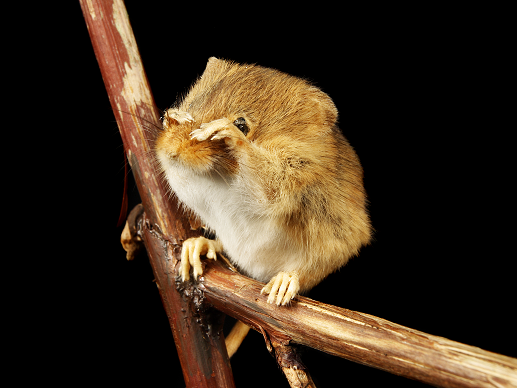
Harvest Mouse
A moose, or mouse in English, might conjure frightful images of being ‘loose aboot yer hoose’, but they often crop up as quite sympathetic creatures in Scottish folklore.
Mice appear twice in the 15th century collection of fables based on Aesop’s work by Scottish poet Robert Henryson, both in the tale of The Twa Mice and The Paddock and the Mouse, where mice serve as sympathetic creatures, although only The Twa Mice has something approaching a happy ending for the titular mice.

A far better-known work is Robert Burns’ To a Mouse, where the poet talks to a field mouse whose home he has accidentally destroyed and reflects on the parallels between the vulnerable creature and his own situation:
Still, thou art blest, compar’d wi’ me!
The present only toucheth thee:
But Och! I backward cast my e’e,
          On prospects drear!
An’ forward tho’ I canna see,
          I guess an’ fear!
On a more mythological note, there exists in Scottish mythology a larger-than-average mouselike creature called a lavellan, which was a malign little creature lurking in deep pools and wells. It possessed a tremendously powerful poison, which made the creature a dreadful prospect for highland communities if one got into the local drinking water.
A Moose, (the Wee, sleekit, cowrin, tim’rous beastie) should not be confused with what in British English is called an Elk (a large antlered creature related to deer). This is commonly referred to as a Moose in North American English. Even more confusingly, “elk” in North American English, refers to another type of deer…
Stone arrowheads – or ‘elf shot’
Fairy folklore forms a central part of Scottish myth culture, yet they were often quite different to the rosy-cheeked sprites you might see in modern media.
Scots fairies came in a bewildering variety of forms, ranging from the tall and elegant, but dangerous, elfin knights – to smaller, stranger looking creatures such as brownies.

Some, like brownies, could be benign, even helpful towards humans. While others, like the sadistic redcap, or the blood drinking Baobhan-Sìth, were malignant, and presented a clear threat to people who might stray too far away from well-worn paths.
Occasionally, people would find tiny stone arrowheads like these, and believed the delicate pieces of weaponry were the enchanted bolts, called ‘elf-shot’, used by elves and other sprites to inflict magical wounds on humans and animals.
These bolts could also be used as amulets to protect you from malign fairies and could be used to cure people and animals from disease caused by mischievous fairies – also called being ‘elf-shot’.
Supporting Scots
Scotland has a rich and vibrant culture. Its folklore and linguistic heritage is something we should celebrate, explore, and discuss. No matter where you’re from, or where you end up, greater awareness of our own cultures, what influences and interactions have shaped them, and how they can be a source of inspiration and expression, can make us more receptive to others.
This, in turn, can lead to the creation of new traditions, new stories, and new forms of expression in the modern world, while still retaining respect for the pasts and heritages that shaped who we are.
Hopefully you’ve enjoyed these samples of what we want to share. We hope they might remind you of something you’d forgotten, taught you something new, or simply made you smile. Happy St Andrew’s Day!
There are more brilliant blogs stretching right across our collection for you to explore – covering coins, medals and much more!
Interested in what’s going on at The Hunterian? Why not subscribe to our mailing list for latest news, and updates on our exhibitions and events?
