
It’s Insect Week!
Organised by the Royal Entomological Society, and supported by partner organisations throughout the UK and Europe, Insect Week is a celebration of all things insect.
Wherever you live, it’s an opportunity to take part in insect science, get to know insects, learn from experts, and have fun.
Getting us in the swing of things is Emma Plant, a second year PhD student from the University of Glasgow’s School of Biodiversity, One Health and Veterinary Medicine.
Here, Emma talks us through the research currently underway looking at pollinators in private green spaces in Glasgow.
The University of Glasgow, in partnership with Glasgow City Council, are working on a £10.2 million research programme called GALLANT, or ‘Glasgow as a Living Lab Accelerating Novel Transformation’.
GALLANT aims to find solutions for a climate resilient Glasgow, tackling issues from active travel, flood risk, vacant and derelict land, to sustainable energy and biodiversity loss.
When we think about cities, biodiversity may not be the first thing that comes to mind. In fact, many studies have linked urbanisation – the process of converting natural land to urban land – to biodiversity loss.
However, there are some spaces where biodiversity can persist. Glasgow’s flora and fauna benefit from numerous parks and green spaces dotted throughout the urban mosaic.
Assessing pollinator diversity
Pollinators can make good use of limited urban green spaces, with a higher diversity and abundance of pollinators in urban parks than farmland.
However, we know very little about what habitat is provided by private green spaces, such as residential gardens, and how the management of these spaces could influence the pollinators that are found there.

It is important to understand this as, collectively, private green spaces could make up a large amount of habitat across the city.
The aim of my PhD is to assess pollinator diversity in gardens and allotments and to analyse which aspects of the environment in these green spaces influence the abundance of individual pollinators and the number of different pollinator species.
Collecting Pollinators
To do this, I undertook my first field season last year (2023) and spent the summer months collecting pollinators from the flowers in people’s gardens.
I recorded not only the species of insect that was pollinating the flower, but also which flower it was pollinating – so that I could get an understanding of flower preference.
Generally, most other studies that have carried out similar experiments have not identified pollinators to species level. Instead, studies group them to morpho species level – such as bumblebee, honeybee, hoverfly, beetle, or wasp.
Instead, I wanted to identify specific species of bee, hoverfly and butterfly in order to obtain more detailed information about pollinators.
Some pollinator species can be readily identified in the field, such as bumblebees and butterflies.
However, many hoverflies and solitary bees require careful examination under the microscope to look at minute differences in features such as hair colour and structure, the shininess of body segments and curvature of veins in the wing.
Identifying species and their spaces
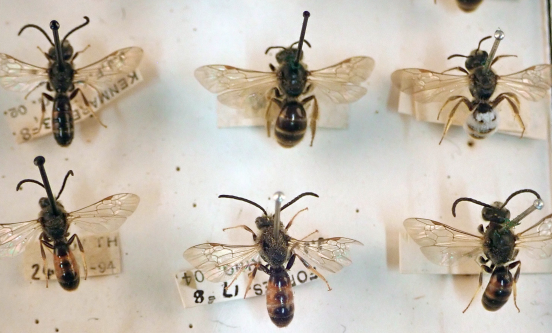
To help me identify species, I used the collections at The Hunterian to compare with the specimens that I had caught. Having a labelled voucher specimen is invaluable when trying to determine between two features in an identification key.

Overall, I identified 58 pollinator species across 19 gardens, showing the importance of these green spaces for pollinators.
Most of the species were hoverflies. Two of these hoverfly species, Meligramma guttaum and Sphegina verecunda, were previously unrecorded in Glasgow.
This highlights the importance of identifying to species level, to record species distribution and changes in these distributions over time.

Later this year, I plan to repeat field work, expanding my sampling pool to include allotments and sampling during both spring and summer.
Again, I will be relying on the Hunterian collections to aid my identification of species, and I am pleased that my work will be added to the collections for future use.
Stay up to date with all things Hunterian via our blog.
