
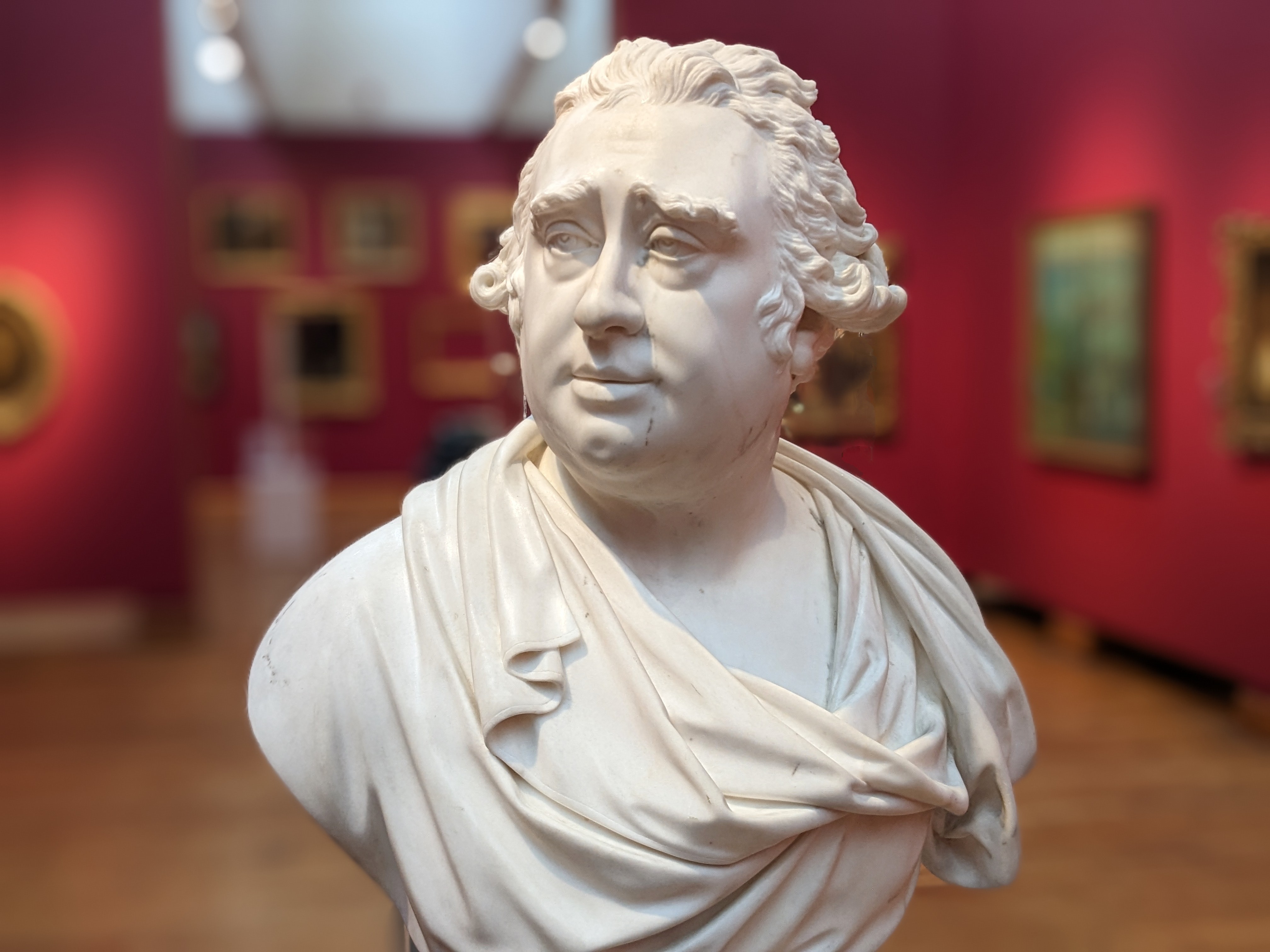
The Hunterian recently added two significant 18th century white marble busts to its collection. On long-term loan from private collectors, they are on display as part of the reframing of our art collection.
Here, we take a closer look at the portrait bust of the famous Whig politician, the Hon. Charles James Fox (1749–1806). The portrait is by Joseph Nollekens, often described as the greatest British sculptor of portrait busts in the second half of the 18th century.
Its inclusion in the reframing of our collection highlights the significance of sculpture in the past, while offering fresh opportunities to question historic practices.
The Hon. Charles James Fox (1749–1806), whose mother was a patient of Hunterian founder Dr William Hunter, was considered the greatest British parliamentary orator and most charismatic politician of his era.
Joseph Nollekens excelled at catching the appearance of his sitters. In his study of the great politician, Nollekens captured the ferocious energy of Fox, reflected in the turn of his head and the dishevelled wig, a remarkable achievement in itself.
The bust, described as Nollekens’s ‘most celebrated portrait sculpture’, is a masterpiece in the Baroque manner.

The Hon. Charles James Fox
Fox was a strong supporter of the American colonies in their disputes with the British government. He also opposed British policy in India, and the treatment by the British East India Company and the British governor Warren Hastings of India’s indigenous population.
He later came to support the French revolution. His admiration of Napoleon led to his increasing unpopularity in Britain after Britain went to war with the French.
Fox and his Whigs spent the greater part of 30 years or more in opposition. However, Fox’s own time in government amounted to only a few years, initially in the 1780s. Later, he was Foreign Secretary and the unofficial head of a government led by Lord Grenville in 1806.
By that time, Fox was already seriously ill, and he died a few months after taking office. This was not before giving strong support to the abolition of the trade of enslaved people – which he abhorred.
Nollekens: Fitzwilliam, Fox and Fame
Joseph Nollekens was commissioned to produce the bust of Charles James Fox by Fox’s closest and lifelong friend, the 4th Earl Fitzwilliam, a famous Irish and British peer who was Lord Lieutenant of Ireland.
When the first marble was exhibited at the Royal Academy in 1791, it became instantly famous. This was after Catherine the Great, Empress of Russia, an admirer of Fox, asked Fitzwilliam if she could have a marble replica.
Instead, the Earl gave her that very first bust of Fox. That original bust is now in The Hermitage in St. Petersburg.
The Earl then commissioned a marble replica for himself. Several of Fox’s friends subsequently requested Nollekens to produce copies for them too.
This brought the sculptor fortune, and at the height of his own fame as an artist, his portrait was painted depicting him with the bust – which is at the National Portrait Gallery, London.
The bust on loan at The Hunterian – the final version commissioned by Fitzwilliam – was given by the Earl to Fox’s ‘secret’ wife and long-time lover and companion, the courtesan Elizabeth Armitstead, and was displayed in their home at Chertsey, Surrey.
What Makes a Portrait?
Nollekens’s sculpture is currently on display in The Hunterian Art Gallery as part of Room 3 – entitled ‘What Makes a Portrait?’.
Portraits do more than represent a person’s likeness, and this room explores the different ways portraits express someone’s identity. Historically, in Western culture, portraits were commissioned by wealthy patrons who would sit for the artist.
As the product of a patron’s desires and an artist’s paid labour, portraits often convey symbols of power, wealth, importance, authority, virtue, status or beauty.

Indeed, Nollekens captures more than just a likeness in this bust of Fox. All of Fox’s physical characteristics, often commented upon by his contemporaries, are skilfully highlighted.
There is his sheer bulk; the prominent dimple on his chin; his piercing eyes; and his famous shaggy eyebrow that led one of his friends to refer to him as ‘The Eyebrow’.
Commissioned by his best friend, the bust was meant to convey the charisma and intellectual vigour of Fox to those who would encounter his likeness throughout the centuries.
The Hunterian collections include several other portraits of the politician that make for an interesting comparison when considering what makes a portrait.
There is a portrait print relying on traditional iconography associated with power to highlight his status, and a medallion by James Tassie (1735-1799) deriving from the iconic portrait created by Sir Joshua Reynolds (1723-1792) in 1782.
There are also two caricatures by Thomas Rowlandson (1756-1827), presenting a definitively less flattering interpretation of Fox’s character – one from 1784, and the other published in 1788.
This highlights the way art has been utilised in the past to transmit certain views to the public about the artwork’s subject, or even to act as symbols of status for those who possess the work. Depending on the mode of art chosen, perceptions can be influenced in the short-term, or much longer legacies can be created.
Reframing our collections
The portrait by Nollekens is one of two 18th century marble busts recently added to our collection as loans. Both of have impeccable provenance and had earlier been on loan respectively to the Victoria and Albert Museum and the National Portrait Gallery, London.
Their owners felt that The Hunterian, as a University Museum dating back to the 18th century, would be a most suitable new home for the busts. They are particularly interested in the opportunities for fresh interpretation and study, by visitors and by students.
Looking from new perspectives, the revamped displays in our gallery rehang ask questions such as: ‘How do art and history influence each other?’ ‘What can one picture tell us?’ ‘What counts as art?’ ‘How are artworks made?’
Find out more about The Hunterian Art Gallery and plan your visit.
Stay up to date with all things Hunterian via our blog. We’ll have more features about the Art Gallery rehang in the coming weeks and months – as well as stories from right across our collections!
