
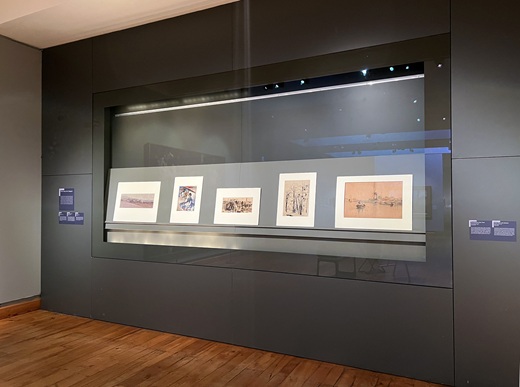
At the Hunterian Art Gallery, our latest rotation of works on paper features a selection of drawings, prints, watercolours and pastels by Scottish artists.
The works have been chosen to coincide with the 200th anniversary of the Royal Scottish Academy, celebrating the contribution these artists have made to the development of Scottish art.
Museum Studies postgraduate student, Eve Park, highlights the themes and stories behind some of the featured works.
The Royal Scottish Academy at 200
In 2026, the Royal Scottish Academy (RSA) celebrates its 200th anniversary. Founded and based in Edinburgh, it’s an artist-led institution that aims to train and promote Scottish artists.
In 1838, Queen Victoria granted a royal charter, strengthening the RSA’s legitimacy and national significance. Achieving membership is no easy feat. Until 2005, to be elected as an Academician relied on the resignation or death of an existing member in the same artistic discipline.
For the Hunterian Art Gallery’s summer rotation of works on paper, most of the artists that feature have been elected to the Academy.
Exploring the artistic journeys that led to membership highlights how difficult the election process is but also helps us appreciate the artworks even more.

The Glasgow Connection
When selecting works for this rotation, something striking emerged: nearly every artist featured had studied at The Glasgow School of Art (GSA). This shared beginning unites the works and celebrates the RSA’s bicentenary in a way that is particular to Glasgow.
Although an iconic institution in its own right, GSA wasn’t always as internationally renowned as it is today. Opening in 1845 as The Glasgow Government School of Design, it was a technical school founded by local manufacturers. The intention was to train designers and architects to support the city’s growing manufacturing industries.
Over time, as more middle-class students arrived and demand for contemporary art grew, the school shifted towards fine arts – creating tension between artists and more traditional designers.
The reforms of headmaster Francis Newbery were central to shaping the School. Inspired by the Arts and Crafts movement, he believed in the importance of creative freedom. The core course became more multidisciplinary than ever.
Instead of students replicating established styles, they were encouraged to explore their own artistic voice – guided not by designated teachers, but by practising artists, many of whom were women. This wasn’t just different; it was radical for its time.
Women and Artistic Recognition
The majority of the works selected in the rotation are by male artists – a reflection of the very real obstacles women faced in Scottish art institutions in the 19th and 20th centuries, the periods from which much of The Hunterian’s collection of works on paper linked to Royal Scottish Academy members and associates originates.
At this time, although women were allowed to enrol as students at the Glasgow School of Art, the Royal Scottish Academy was slower to admit them as members. In 1885, the RSA President, Sir William Fettes Douglas, even claimed that women’s artwork was ‘like a man’s only weaker and poorer‘.
One exception was Christina Robertson, who was elected just three years after the Academy was founded. She is often overlooked having moved to Russia, where she became known for her portraits of the imperial family.
Unable to participate in the Academy’s activity from such a distance, she was given the title of ‘Honorary Academician’ (HRSA) instead.
The RSA didn’t elect another woman until the late 1930s. Of the women admitted to the RSA, two feature prominently in the selection of works chosen for our rotation.

Mary Armour’s story is one of quiet determination. Early in her career, she was required to resign from teaching when she married – a common requirement at the time. Despite this setback, she continued to create and became a foundational figure in the Milngavie Art Club.
After the marriage ban was eventually lifted, she returned to the Glasgow School of Art as a teacher, later serving as both Governor and Honorary President.
She became a respected mentor to many prominent Scottish artists, including John Byrne, who recalled her encouraging him not to undersell the work in his first exhibition.
Joan Eardley’s path was different, but equally significant. She won a scholarship from GSA and prize money from a students’ competition at the RSA – recognition that opened doors and allowed her to travel.
The work on display, a scene of an Italian hill town, reflects the increased institutional support and recognition for female artists that was finally beginning to emerge.
Challenging Institutions
Our selection of works for the summer rotation also explore tensions between artistic identity and institutional expectations. We feature a print by John Byrne, whose artistic journey was particularly unconventional.
After being told he’d need to resit his first year at the Glasgow School of Art, he made the controversial decision to leave – believing the institution was too restrictive. Byrne then switched to Edinburgh College of Art, only to find it even more constraining.
He would return to GSA to complete his diploma, before attempting to break into the London art scene. Here, he signed and exhibited under a different identity – his father’s name – and presented himself as a self-taught artist.
This story reflects wider tensions within Scottish art during this period, especially between Glasgow and Edinburgh. Institutions like the Royal Scottish Academy were viewed by many progressive artists as conservative and resistant to new styles.
The Glasgow Boys – a group of innovative artists – refused to submit any work to the RSA for exactly this reason. Only when fellow artist James Guthrie was elected to the Academy (and later became President) did they begin to reconsider their stance.
Mentorship and Artistic Community
Alongside these stories of exclusion and tension, the rotation also celebrates the generosity and creative support of artistic communities.
We see this best in Capriccio by Robert Colquhoun, created in Italy and made possible through a travel scholarship from GSA. Like Eardley, Colquhoun’s talent was rewarded with this opportunity.
What makes this story more compelling is that his long-term partner and fellow student, Robert MacBryde, was able to accompany him thanks to the school’s Governors.

They had reportedly struggled to decide between the pair on who should receive the scholarship award. Believing that Colquhoun would likely divide the funds between the pair, the Chairman of the Governors generously matched the amount to give to MacBryde too.
This allowed them to spend significant time in Italy together – a gift that speaks volumes about the ethos of GSA and the encouragement that could be found within its community. Colquhoun’s Capriccio, created during this Italian trip, is a moving testament to this theme. Although Colquhoun was never elected to the Royal Scottish Academy, his story – and this work – reflect the values that made Glasgow School of Art such a fertile ground for artistic development.
Discover More
If you’d like to hear more about the other works on display as part of the rotation, including those by James Paterson, Duncan Shanks and James Kay, join us online for a Friday Focus talk on 29 May 2026.
During the talk, Eve will explore the rotation’s selection process in more depth, offering a behind-the-scenes look into why each work was chosen and what didn’t make the final selection.
This group of works will be on display from 18 May until 20 September 2026. The Gallery is open Tuesday-Sunday, from 10am until 5pm, and admission is free.
There are more brilliant blogs stretching right across our collection for you to explore – covering art, coins, medals and much more!
Keep an eye out for all the latest events at The Hunterian via our website – or subscribe to our e-news mailing list.
Further Reading
The RSA
Alice Strang, Art UK. ‘Pioneering Women at The Royal Scottish Academy’.
The Royal Scottish Academy, ‘Our History’.
The GSA
Brownrigg, J. (2018). ‘The ladies would seem to have turned their attention: tracing the founding‘. The Glasgow School of Art.
Mathas, J., ‘The Glasgow School of Art as a “Radical Laboratory’. Art Media Agency (AMA).
Rawson, George Mansell (1996). Francis Henry Newbery and The Glasgow School of Art. PhD thesis.
Mary Armour
The Royal Scottish Academy. Mary Armour RSA, 1903-2000.
Joan Eardley
Elliott, P. (2016). Joan Eardley: A Sense of Place. National Galleries of Scotland.
John Byrne
Harris, P. & Halsby, J. (1998). The Dictionary of Scottish Painters: 1600 to the Present. Edinburgh: Canongate Publishing.
Hewison, R. (2011). John Byrne: Art and Life. Surrey: Lund Humphries.
Robert Colquhoun
National Galleries of Scotland. ‘Robert Colquhoun, 1914-1962’.
