
Zandra Yeaman, Curator of Discomfort, The Hunterian | University of Glasgow.
This blog first appeared on Between Deception & Dissent as part of April Fakes Day 2026.
April Fakes Day provides an opportunity to explore the complexities of fakery and its role in shaping our understanding of reality, drawing on collections, research and stories to celebrate curiosity, creativity and critical thinking.
In collaboration with Professor Patricia Kingori at Oxford Population Health’s Ethox Centre, University of Oxford, and Professor Emilie Cloatre at King’s College London, institutions across the UK and Ghana spotlighted fakes in science and pseudoscience.
Race science is one of history’s strangest intellectual performances: a group of people determined to prove a conclusion they already believed, armed with rulers, skulls, and an impressive amount of confidence.
From the eighteenth through the nineteenth centuries, European and American scholars attempted to classify humanity into biological ‘races.’ Charts were drawn. Measurements were taken. Latin words were added. It all looked extremely serious.
The trouble was that the ‘science’ worked backwards. The hierarchy came first, and the evidence was asked, very politely, to cooperate.
Despite its dubious foundations, race science proved remarkably useful. It helped justify systems of exploitation, including chattel slavery, and its influence still lingers in institutions such as museums.
When Pseudoscience Met Chattel Slavery
During the era of the Transatlantic Slave Trade, defenders of chattel slavery began upgrading their arguments.
Earlier justifications had relied on religion or economics. By the nineteenth century, however, a more modern approach emerged: science. Instead of saying, ‘we want cheap labour,’ the argument became, ‘science shows that Africans are naturally suited to labour’.
This had a convenient advantage. It transformed slavery from a moral choice into a biological inevitability.
One of the most enthusiastic contributors to this effort was Samuel George Morton, who collected hundreds of human skulls and measured their internal volume. His conclusion that Europeans had the largest brains and Africans the smallest aligned perfectly with the social hierarchy of his time. A remarkable coincidence.
Another figure, Josiah C. Nott, took things further by arguing that human ‘races’ might be separate species altogether. This was a helpful idea if one wished to resolve the moral discomfort of slavery. Mainly by redefining the people being enslaved.
The ‘Science’ Behind the Claims
If race science had been accurate, it would still raise serious ethical questions. Unfortunately, it was not even particularly good science and had no basis on reality.
Skulls were measured inconsistently. Samples were biased. Data that contradicted expectations had an unfortunate tendency to disappear. The process had all the outward signs of scientific rigor, but the reliability of a horoscope.
Later scholars revisited these studies. Among them was Stephen Jay Gould, who argued that Morton’s work reflected unconscious bias in measurement and interpretation. While historians continue to debate the details, the broader lesson remains. Scientific methods are not immune to human assumptions, especially when those assumptions are doing the work to support the biases.
In other words, the numbers were presented as objective. The process that produced them, not so as the legacy is racism, prejudice and discrimination.
Museums and the Afterlife of Race Science
The era that produced race science was also busy building museums.
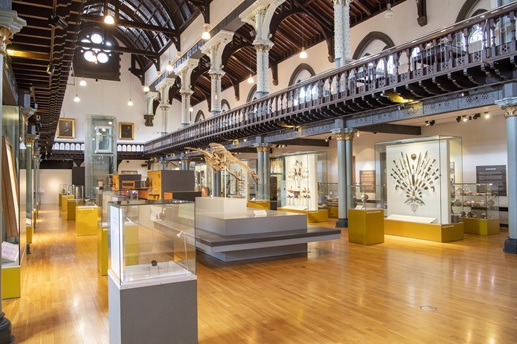
University museums such as The Hunterian based at University of Glasgow and Institutions such as the British Museum, the Smithsonian Institution, and the Musée de l’Homme assembled vast collections of artefacts, human remains, and cultural objects often acquired through colonial networks that were, at best, ethically flexible.
These collections were then carefully organised according to categories that reflected the same worldview as race science.
European objects were sorted into neat historical narratives: Renaissance, Baroque and Classical chapters in a story of progress.
Objects from Africa, Oceania, and the Americas, meanwhile, were frequently grouped under headings like ‘tribal,’ ‘primitive,’ or ‘ethnographic.’ Still a structure used today, however not in the Art collections.
The message was subtle but unmistakable. Europeans had history and art. Everyone else had… anthropology.
When People Became ‘Specimens’
If the labelling of objects was questionable, the treatment of people was far worse.
During the nineteenth century, human remains were collected as ‘racial specimens’. Skulls and skeletons were taken from burial sites or from colonised populations, often without consent and usually without much concern.
One of the most disturbing cases is that of Saartjie Baartman. Brought to Europe in the early 1800s, she was exhibited as a curiosity. After her death, her body was dissected and displayed for over a century at the Musée de l’Homme.
She was finally returned to South Africa in 2002, which is a long time to wait for basic human dignity.
Her story illustrates how easily scientific curiosity can become dehumanisation. Particularly when the subjects of study are denied a voice in how they are represented.
Why the Legacy Still Matters
At this point, it may be tempting to laugh at race science and, to be fair, it often invites it. Measuring intelligence by skull size now sounds about as credible as determining personality from tea leaves.
But the consequences were not funny.
Race science helped justify slavery, colonial rule, segregation, and discriminatory laws. Even after the theories collapsed, the systems they supported proved remarkably durable. The hierarchical systems and structures in institutions that we navigate everyday are a testament to this.
Modern genetics tells a very different story. Humans are approximately 99.9 percent genetically identical. Variation exists, but it does not align neatly with traditional racial categories.
Those categories were social inventions. Very influential ones.
Rethinking the Museum
Museums today are increasingly confronting this history.
Questions are being asked that might have seemed unnecessary a century ago:
Who created these categories?
How were these objects acquired?
Who gets to interpret them now?
For example, at The Hunterian we are working towards repatriation of human remains and cultural artefacts. We are rethinking how collections are labelled and displayed.
It is, in many ways, an attempt to turn the museum from a cabinet of certainty into a space of conversation.
The Real Lesson
Race science is easy to mock, and in many respects, it deserves it. There is something inherently absurd about elaborate measurements designed to confirm what their authors already believed.
But its real significance lies in how effective it was.
It shows that scientific language can be used not only to discover knowledge, but to justify existing power structures with graphs.
The challenge today is not just to recognise the absurdity of past ideas, but to remain alert to similar patterns in the present such as moments when conclusions arrive first and evidence is invited in afterward.
The measuring tapes may be gone. The confidence, unfortunately, is still available.
