
As part of the Glasgow 850 celebrations, Hunterian Visitor Experience Assistant Jenni Webster delves into the life and work of the prolific Scottish print-maker Willie Rodger.
Bold lines, block colour and tantalising subject matter – artist Willie Rodger’s prints take each of these to the extreme.
Ranging in size from A6 (and smaller) to large-scale A1 pieces, Rodger’s prints explore a plethora of stories, figures and themes pertaining to all walks of life.
Life and Art of a Scottish Printmaker
Born and raised in Kirkintilloch, a small town on the outskirts of Glasgow, Willie Rodger knew from a young age that he wanted to be an artist.
He was accepted into Glasgow School of Art in 1948, going on to specialise in Graphic Design and Printmaking, and was soon recognised as a remarkably skilled draughtsman and relief printer.
He created and exhibited work extensively throughout the mid to late 20th century, as well as enjoying a successful teaching career at both Lenzie Academy and Clydebank High School (latterly as a department head).
After retiring from teaching in 1987, he went on to pursue freelance work until just a few years before his death in 2018. Rodger is survived by his family and a large collection of work, consisting of hundreds of prints, proofs and other multi-media work such as stained glass and sculpture.
The Willie Rodger Collection: A Major Acquisition
I recently had the opportunity to see the work of this fantastic artist up close, as The Hunterian had acquired a large number of his prints. My colleague and I were invited to Kelvinhall (The Hunterian’s main storage facility) to chat to the curator of French and British Art, Anne Dulau Beveridge.
We were shown some prints from the recently acquired Willie Rodger Collection to learn how to properly catalogue them. This work had been previously catalogued by Willie’s son, Robin Rodger, who works as the Documentation Officer for the Royal Scottish Academy of Art and Architecture.

Robin began to manually record his father’s artworks in 1979, attempting to record artworks as they were produced as best he could. He has fond memories of his father creating work and hanging it in their house as he was growing up, with many of the prints conveying subject matter such as family holidays or portraits of family members.
After Willie Rodger’s death, his family sought to gift the artwork to various select heritage collections across the United Kingdom, to preserve their father’s legacy as one of Scotland’s leading printmakers and multimedia artists.
The collection gifted to The Hunterian remains the largest and, in Robin’s words, ‘most important body of [Willie Rodger’s] work in public hands.’
The Hunterian was chosen to house this branch of the Willie Rodger Collection due to his connection with the West of Scotland, the Rodger family’s connection with Glasgow University as alumni, and The Hunterian’s existing collection of prints by Scottish artists.
“Father was a distinguished and singular figure in post war printmaking in Scotland, something recognised by his peers when he became the first person elected to the new category of Associate Printmaker at the Royal Scottish Academy of Painting, Sculpture and Architecture in 1989. Specialising in relief prints, he favoured lino and woodcuts famously printed entirely by hand without the use of a press.
Robin Rodger
His prints are instantly recognizable and display sound draughtsmanship and an absolute technical mastery. Many are acutely observed and reveal a gentle sense of humour. Working independently his contribution has perhaps not been as fairly recognised as his work deserves, but he was highly respected, well-liked and often worked collaboratively with others.”
Cataloguing the Prints and Documenting a Legacy
When it came to cataloguing Willie Rodger’s work, Robin collaborated with his father on how best to present the data. These conversations produced a data capture format based primarily on a work’s title, date, dimensions and edition size.
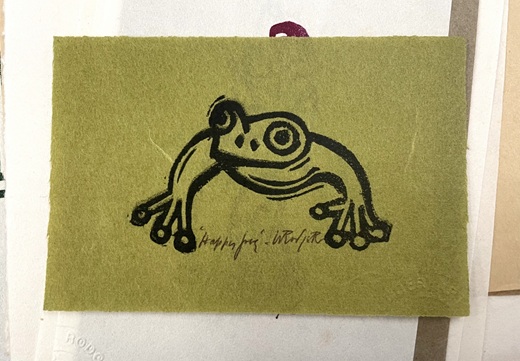
Important notes were also included detailing a work’s exhibition history and any specific technical details. Some artworks were more notable than others – for example, ‘The Hostages’ is a thoughtful piece that conceptualises the capture and internment of prisoners of war, whereas ‘Happy Frog’ depicts a simple outline of a frog on green paper.

After the collection was acquired by The Hunterian, my colleague Chema and I were brought in to help convert the data that had been captured to fit with The Hunterian’s own cataloguing format.
Anne asked us to use SPECTRUM – a collection management standard developed and used within the UK – and apply the existing data to various fields found within this standard.
SPECTRUM not only contains the information already recorded by Robin (title, date, dimensions, etc.) but also includes more detailed fields such as the kind of printing technique used and a detailed physical description of the artwork.
Each piece is then given a searchable catalogue number, to help identify and locate it both within The Hunterian’s online database and the physical collections store.
Analysing the Iconic ‘Clydebuilt’
I have chosen to share and analyse a piece of Willie Rodger’s work that I feel best exemplifies his style.
This print depicts a man with tattoos hammering a large iron nail into a surface. He is shown mid-swing, and thick black lines and a blocky composition give this print a feeling of heft.
The scratchy woodblock aspects of the image – the hammer, nail and surface – help to exaggerate these as inanimate, manmade objects, while the smoother, curved lines used for the figure create a sense of movement and aliveness.

These thick, smooth lines also lend a certain grounded aura to the image – the man seems to be anchored in place, suggesting that he belongs there and is undertaking a task that is fundamental to his daily life.
This image is reminiscent of the shipbuilding factories found along the banks of the river Clyde, which would have been commonplace to those working in and around Glasgow. Glasgow was at one time a global centre for shipbuilding, producing many famous liners, steamboats (puffers), and military vessels among others.
This centre of industry began to decline during the 20th century after damage sustained during the second world war, and many workers were made redundant.
Whilst teaching in Clydebank High School during the seventies and eighties, Willie Rodger would have been in close proximity to John Brown and Co.’s shipyard, where workers such as the one depicted in this print would have been a common sight to behold.
The acquisition of this remarkable work, and the wider collection, ensures that Willie Rodger’s legacy will be preserved and explored by researchers and the public for generations to come.
As part of our ongoing rotation of works on paper, three key prints from the Willie Rodger Collection are currently on display at The Hunterian Art Gallery until January 2026 – including ‘Clydebuilt’.
Looking from new perspectives, the displays in the Hunterian Art Gallery ask questions such as: ‘How do art and history influence each other?’ ‘What can one picture tell us?’ ‘What counts as art?’ ‘How are artworks made?’
Find out more about the Hunterian Art Gallery and plan your visit.
There are more brilliant blogs stretching right across our collection for you to explore – covering art, coins, medals and much more!
Keep an eye out for all the latest events at The Hunterian via our website – or subscribe to our e-news mailing list.
