
In this guest post, Helen Charman reflects on Assembly, Margaret Salmon’s recent exhibition at the Hunterian Art Gallery.
I wrote this in the middle of December 2025, during the part of the calendar year where things seem to slow down and speed up at once. It’s a time of dualism: on the one hand, the demand to escalate all forms of productive activity — professional, social, personal, financial — for the ‘festive season’; on the other, the feeling that, as we approach the winter solstice, we should be bedding down into the darkest part of the year, resting and gathering energy as we reflect on the things that have passed.
It felt appropriate, then, to have been asked to write retrospectively about Margaret Salmon’s Assembly, which ran at The Hunterian from June until October of that year.

This was an exhibition reconfigured as a moveable, living thing: what it held within it changed as the seasons did, with spring, summer, and autumn phases. In this sense, Assembly was as much a project about duration as it was about the notions of collectivity and presence that its title gestures towards. Within this is another dualism: it was not just the work of assembling an exhibition that was documented within the gallery space itself, but the work of making a feature-length film.
Entering, after you had passed the suspended patchwork quilts hanging the stairwell, you were greeted by wall text that announced the exhibition as something always in-progress, a collation of the ‘the research, tests and experiments’ towards the longform narrative film To A God Unknown, which Salmon describes as a ‘feminist existential melodrama and ghost story’ and which was filmed on 35mm throughout the timeframe of the exhibition.

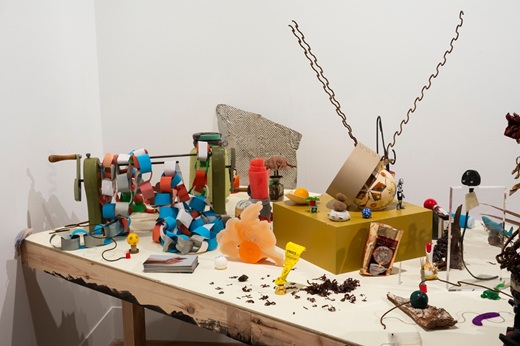
Assembly confronted dailiness, took it seriously. The exhibition was filled with an array of objects that were transformed from their everyday use but retained a ghostly sense of it: hockey sticks, wax, letters, a ball in a bra cup that looked pleasingly like an egg yolk, books about aesthetics and economics, pie crust mix, a copy of Walter Benjamin’s A Short History of Photography underneath a table loaded with plastic sharks, old trainers, Kamala Harris branded chocolate, fake blood and plastic handcuffs next to a discarded kettle filled with dead leaves.
It reminded me variously of a child’s hoarding of precious things, the general detritus of domestic life in a busy household, and the contents of an art classroom. I found the accumulation soothing, and I found it moving: the balance of intellectual theorisation, neatly bound between book covers, and the clutter generated by both raising children and making art, and Salmon’s refusal to participate in the fiction that these parts of life can be separated from each other. It felt like a reclamation of porosity.

Looking together
Film itself is an accumulative negotiation between language and image, and Assembly engaged with this as a form of productive contradiction. On the wall outside the screening room, bits of paper covered in writing were pinned up, a mixture of quotations (‘To be drugged by the embrace of nature into what we call most natural in us, our sleepiness and out sexual desires, is at once a pleasant and an unhappy fate, since what remains immortal in us is both androgynous and sleepless’; ‘A film is difficult to explain because it is so easy to understand’) and notes to self: ‘bureaucratic libido’, ‘I prefer substance over form’, ‘the big other, the big other’, ‘GHOSTS BEFORE BREAKFAST’; and in pencil, quietly along the bottom of a sheet of paper, ‘Margaret, don’t forget to listen’. A cast list in progress, with filled roles crossed off: single mother, pregnant woman, youth worker, wild sleeper, waitress, Father Ghost.

The end of Assembly’s run — the culmination of its autumn phase — was marked by a concert which featured performances by the Govan Allsorts Community Choir, Pippa Blundell, and the beloved Glasgow band Sacred Paws, who, alongside Tracyanne Campbell and Donna Maciocia of Camera Obscura, are collaborating with Salmon on To A God Unknown. (Watching live music together is, of course, another form of joyful and precarious assembly, one that, five years on from the first COVID-19 lockdown, I no longer take for granted). The Govan Allsorts also feature in Salmon’s 2021 film Icarus (after Amelia), a gendered labour study that grapples with the rapidly shifting parameters of living and working during the pandemic, visually performing the disciplinary insights of feminist economics in its loving attention to feminized labour.
Icarus haunts assembly: a note on the wall reads ‘Icarus … spiritual inheritance’, and black and white stills of the body of a pregnant person that appears in the film are displayed elsewhere in the gallery next to a picture of two children holding signs saying ‘our future’ and ‘your greed’ at the 2021 Children’s March that took place in Glasgow during COP26, one of whom is Salmon’s son Ulysses, who plays a character in To A God Unknown. Salmon’s work takes its own material circumstances seriously, and the process of making art is informed by the processes of living together, including mothering.
This ethos extends to the community collaboration that was practically as well as theoretically central to Assembly: it featured work by the artist Jo Sunshine, who also ran a colouring workshop during the exhibition, as well as collaborations with the G20 Youth Project and Amma Birth Companions. During the autumn phase, photographs were displayed of people who had come in for the free community portrait studio, in which Salmon would take two black and white 35mm frames of anyone who attended.
Invisible hands
Feminized labour is, historically, labour that is associated with the domestic sphere: in this way it is also invisible labour, work that, in order to ensure the current socioeconomic status quo, needs to be designated as not being work at all. In Assembly, Salmon renews her career-long commitment to paying attention to what is usually not attended to, perhaps best represented by the black and white footage and film stills of two university cleaners working on the main rooms from the Glasgow home of Charles Rennie Mackintosh and Margaret Macdonald Mackintosh, which is kept in The Hunterian and is the only surviving Mackintosh domestic interior in Glasgow.
I can’t help but find a nod to the Berwick St Collective’s landmark 1975 feminist documentary Nightcleaners 1 here, but it also serves to more broadly emphasise the overlapping relationship between the public and the private, the hidden work that goes into the preservation of a place’s history: what does the reassemblage of something overwrite, obscure? What kind of maintenance does a reenactment of a domestic space require?

Assembly brings its theoretical framework to life; another way of saying this, perhaps, is that it brings life back to theory. At the top of a printed-out article by the theorist Nancy Fraser called ‘Contradictions of Capital and Care’ is a note that reads ‘Olga Futemma: ‘I am me, plus my circumstances’. On a table, a fat, stapled document, many sheets of paper deep, with the HM Courts and Tribunal Services insignia on the top left: the accumulated ‘further evidence’ for Salmon’s own lone parent child benefit appeal. Salmon is an artist, plus her circumstances.
To make feminist work is to be aware of your position in an unstable and precarious lineage, to engage with the invisibility that, historically, has cloaked its bricolage archive. Assembly overflows with its own references, but it brought another text to my mind, too: Holly Pester’s poem ‘The Work and its Record’, which was written from notes made by Pester in the archives of Glasgow Women’s Library. The poem metabolizes the haphazard materiality of feminist history, eventually answering its own question:
what survives? the work and the tradition of living in the worker
in the records of their songs
Assembly seems, to me, to be asking us a similar question. What survives? The work and its record, To A God Unknown and the accumulation of its making. This exhibition that invited us to live with it and, in the film to come, this invitation continues to be extended.

There are more brilliant blogs stretching right across our collection for you to explore – covering art, coins, medals and much more!
Keep an eye out for all the latest exhibitions and events at The Hunterian via our website – or subscribe to our e-news mailing list.
