
Tui Russell introduces Mary Adshead through The Hunterian’s newly acquired archive – exploring lost murals, artistic legacy, and the importance of ephemeral art.
Recently, The Hunterian received a gift: the archive and a collection of works by the painter, illustrator, and designer Mary Adshead.
As it was my role to catalogue and research this material, I was struck not only by Adshead’s remarkable technical ability, but also how her work prompts wider conversations about the ephemerality of mural art and the precarious legacies of women artists.
Admired during her lifetime, yet largely forgotten today, Mary Adshead has recently been highlighted by the R.A.W. (Rediscovering Art by Women) project, in their effort to bring overlooked female artists back into public consciousness.
Early Life and the First Commissons
Mary Adshead was immersed in creative culture from a young age. Her father, architect Stanley Davenport Adshead, was a friend of Henry Tonks, the influential director of the Slade School of Art.
Through this connection, Mary entered the Slade in 1921 aged only 16, where her talent was immediately recognised. Tonks swiftly organised her first major commission: a set of murals for the Paddy’s Goose Club in Wapping, London.

Paddy’s Goose Club: Lost Murals
One of the most beautiful works in The Hunterian’s gift is Mary Adshead’s design for the Joys of the Country murals in Paddy’s Goose Club, the first of four designs she created for the project. These works wrapped panoramically around the room, creating the illusion of being inside the work of art.
On the back of this design Mary describes how the Paddy’s Goose Club building was bombed in the blitz, meaning none of her finished murals survived.
That might make this design the only physically painted evidence of this mural, alongside some black and white copied photographs which I found in the Adshead archive.

Such a loss underscores the fragile nature of mural work. Murals depend entirely on their architectural context; once the building changes or disappears, the artwork often vanishes with it.
In cases like Adshead’s, the archive becomes the artwork’s afterlife. Letters, sketches, photographs, and design drafts become the only way to reconstruct what was once on the walls.
While researching this commission, I found very little online about Paddy’s Goose Club. The archive proved crucial not just for artistic context, but for piecing together the club’s multiple names, locations, and history.
This turns the design itself into an artwork with new meaning, no longer tied to a surviving wall.
Pageantry, Britishness and Soft Power
One of the interesting aspects of public mural work is their need to appeal to and interest a wide range of people. Often this means the chosen themes can reflect the mood of a city or even a country at a particular time.
This can be seen in Mary Adshead’s post war murals. The theme of ‘Britishness’ and British history take on a new prevalence as a reflection of post-war Britain’s national pride.


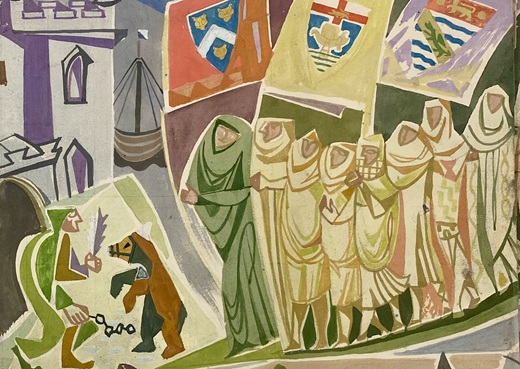
Her design Midsummer Eve Pageant of the Guilds, created for the restaurant of Lewis’s department store in Bristol, mixes medieval imagery with a distinctly modernist style.
It draws on the tradition of religious pageants in the medieval era, where guild members would perform biblical stories for the people of the town in a precession of carriage stages. Mary Adshead symbolises these through the vignettes of characters spread across the design.
It’s interesting to think about medieval pageantry as a piece of public ephemeral artwork itself, and therefore Mary’s mural work is enacting the same performance – creating a colourful celebration for the public to enjoy.
The Commonwealth Institute Mural
Another example, her mural of William Longsword, formed part of a series commissioned for the opening of the Commonwealth Institute in London in 1962.
The Institute aimed to present a polished, idealised image of Britain, opened with the aims of ‘fostering the interests of the commonwealth’ – celebrating British influence and the Commonwealth’s global reach.

This was a message already at odds with the political reality, as many former colonies were pursuing independence at the time.
Adshead’s mural, celebrating medieval heroism and national history, becomes a form of soft propaganda.
Just as the Commonwealth Institute aimed to portray an idealised image of Britain’s colonial past, this mural depicts a similar image of British history, while reflecting the tensions between Britain’s self-image and its shifting international role.
Materials, Design, and the Archive’s Hidden Clues
Many works in the Adshead gift are designs rather than completed murals. These designs often give little indication of the materials or techniques Mary intended to use.
This makes it challenging to imagine the finished pieces, especially when scaled up to full mural size.
One exception is a design that describes incorporating encaustic tiles, which offers a clearer sense of how the final mural might have appeared, as well as highlighting Adshead’s skill at a range of crafts.

More clues on materials emerged from the archive, including a set of mirrored tiles, likely used in one of her mosaic or mixed-media projects.
These examples demonstrate the richness of Adshead’s material experimentation and remind us that mural art often leaves behind traces and fragments rather than intact final works.

Adshead at Home: Understanding Her Personal Style
Designers can be difficult to understand outside the constraints of a commission. One of the best ways to see an artist’s more personal style is through the objects they created for their own living spaces.
Adshead and her husband, artist Stephen Bone, lived in a home known as The Barn. She designed many of the furnishings herself, including the Zephyr and Boreus screen.
The archive contains both the original design and photographs of the couple at home with the finished piece behind them.


What’s most interesting, is how different the final object is from the design. The original drawing shows only two panels, whereas the finished screen has four.
This hints that designs are rarely fixed points; they evolve and adapt in the making, further highlighting the importance of looking at designs as works in their own right and not exact copies of the final piece.
Preserving Adshead’s Legacy
Working with the Adshead gift has reinforced how essential archives are for reconstructing an artist’s life and preserving works that no longer exist in physical form.
Adshead’s murals were ambitious, public, and deeply tied to the spaces they inhabited, qualities that also made them vulnerable to loss.

Through surviving designs, photographs, letters, and materials, we can begin to restore her place in the history of British art and design.
Adshead deserves recognition not only as a technically skilled muralist, but as a commentator on national identity, public art, and the lived experience of twentieth-century Britain.
There are more brilliant blogs stretching right across our collection for you to explore – covering art, coins, medals and much more!
Keep an eye out for all the latest events at The Hunterian via our website – or subscribe to our e-news mailing list.
