
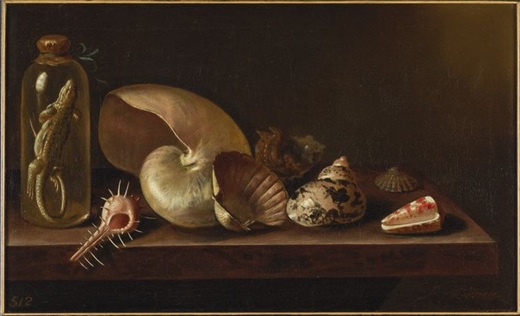
Ever wondered how an artwork ends up in a collection? Art Curator Dr Lola Sánchez-Jáuregui reveals The Hunterian’s intricate acquisition process and details her detective work tracing the story of a 17th-century still life painting.
One of the most thrilling — and also most intricate — parts of a curator’s job is initiating the art acquisition process to add new pieces to the collection.
Acquisition isn’t just about choosing something beautiful or interesting. It requires assessing collection gaps, future directions, and long-term storage, display, teaching, and research needs.
Once an object enters our collection, it becomes our perpetual responsibility — for now and for generations to come.
In this blog post, I’ll take you behind the scenes of a recent acquisition at The Hunterian, sharing the curatorial process, extensive research and serendipity that brought a remarkable 17th-century painting into our care.
“Luck is what happens when preparation meets opportunity.”
Seneca
Artworks can join our collection through various routes: purchase, commission or donation. They might come from antique dealers, designers, private individuals or auctions. Sometimes we’ve been tracking specific artists for a long time. At other times, as in this case, the process begins with a chance encounter at an international art fair.
In March 2024, I participated in the TEFAF Curator Course, an initiative designed to equip museum curators with first-hand insight into the art market. At the core of the programme was a visit to TEFAF Maastricht, one of the world’s leading art fairs.
After hours wandering through dealer stalls, a small painting caught my eye. It was a still life: seashells and a lizard in a glass jar.

The artist?
A signature in the lower right corner of the canvas pointed to it: “P.v. Roestraten” – a name that sparked my curiosity immediately.
Is the Work Right for the Collection?
Answering the question, “Does this belong in The Hunterian?” took months of considerable effort.
Acquiring a piece involves a rigorous internal acquisition process with several critical steps. Beyond artistic merit, we must carry out extensive due diligence.
- Provenance Verification: We must confirm the piece isn’t stolen or illicitly traded and that its owner has the legal right to sell it.
- Acquisition Justification: We dive into research to build a compelling case for why the work belongs in our collection, considering its historical and artistic context.
- Conservation Assessment: We evaluate its current condition and long-term conservation needs.
- Institutional Alignment: We check its relevance to existing works and alignment with our institutional priorities.
- Financial Planning: We develop a budget that covers the acquisition cost, transportation and insurance, as museum acquisitions require dedicated funding.
Finally, an internal committee, the Collections Development Group, evaluates everything and presents its recommendation to the management team.
Piecing Together the Puzzle: Researching Pieter van Roestraten
The research phase was the most exciting part. Who was P.v. Roestraten? What made this work significant? And how might it fit into The Hunterian’s unique collecting philosophy?
With the help of Tui Russell, our Curatorial Assistant, we began our investigation by searching the archives of the National Library, National Records and National Gallery of Scotland. We reviewed different publications, PhD theses and secondary sources. Little by little, the painting’s story began to unfold.
Pieter van Roestraten (1630–1700) was a Dutch painter known for his exquisite still lifes. He trained under Frans Hals, whose daughter he would marry and move with to London. It was here van Roestraten developed a successful career, specialising in still life works.
Our working hypothesis was that the painting we were curious about must have been acquired in London.
It was most likely purchased from the artist by Robert Kerr (1636–1703), the fourth Earl and first Marquess of Lothian. Lothian had amassed a formidable collection of artworks, which he housed at the family residence at Newbattle Abbey.
He admired Dutch Old Master paintings and likely acquired them during his studies at the University of Leiden.
Lothian’s collection included works by Hans Holbein, Anthony Van Dyck, Albrecht Dürer and Lucas Cranach the Elder. It even featured his own portrait, painted by Dutch artist Simon Verelst (1644–1721).
Judging by this collection, our small still life would almost certainly have been to his liking.
The painting may have been acquired in the 1690s during a trip to London, where he acquired numerous works. He wrote about them to his wife in Scotland. In one letter, dated 1693, in which he describes a painting, he writes:
“I have really got some of the prettiest things as little pictures for your closet. You can imagine a picture of shells. You will ademeere[sic]”
Could this be our painting?
The Final Clue: An Inventory Number
The final piece of the puzzle?
A small number: “512”, painted in the lower left corner …
Over the centuries, various sales dispersed the Lothian collection, and today the paintings can be found in a range of public collections and auction catalogues.

We located other paintings from the Lothian collection bearing similar numbers to the still life we were investigating.
After some further research, we were able to trace the number on the painting to an 1878 drawing of a Newbattle Abbey staircase, which showed a diagram of hanging paintings.
There it was: number 512, located above the stairs, matching the one inscribed on our painting. Stylistic, historical and documentary evidence—the clues started fitting together.

Unpacking the Meaning: Art, Science and Symbolism
At first sight, we see silent shells and a lizard. Look closer and layers of history, symbolism, religion and science unfold.
The beauty and fascinating appearance of seashells enchanted collectors during the 17th and 18th centuries.
Interest and demand increased dramatically due to colonial exploitation by the British and Dutch East India Companies. This sparked a “shell mania” across Europe.
People avidly sought them, and depending on their rarity, they became very expensive. As precious and rare objects found their way into collectors’ cabinets, they also began to take centre stage in paintings like this one.
The message? The shells were proof of the owner’s wealth, social position and their curiosity in natural history. They convey the ideas of natural theology: an appreciation and interest in nature as a reflection and proof of Divine Creation.
Our Curator of Zoology, Mike Rutherford, identified the provenance of some of the shells: Murex, Nautilus, Pica and Conus from the West African, Pacific and Caribbean coasts, along with others of European origin.

The origin of the lizard in the jar is harder to identify, but its inclusion is exceptionally rare because it constitutes an early example of a wet specimen.
The history of zoological preservation in alcohol and ‘spirits’ dates back to the 17th century. Its inclusion in this painting, around 1690, adds a new scientific and historical dimension to the artwork.
The idea of bringing art lovers and natural history scientists together in a dialogue in front of this painting made the work most compelling for our collection.
The provenance showed we would not only acquire a beautiful painting but also recover an important chapter in the Scottish history of collecting.
The Final Step: Funding and Justification
With the painting’s history and provenance confirmed, the owner’s legality clarified, and its value to the collection demonstrated, our task was nearly complete — except for one crucial detail: finding the funds.
While The Hunterian is fortunate to have modest funds for purchasing new works, our budget is often insufficient.
For this major art acquisition, we turned to other sources, requesting assistance from public funds. We are incredibly grateful to the National Fund for Acquisitions for contributing a quarter of the total value of the painting through a grant application.
Scholarship, intuition, negotiation, collaboration and logistics carefully orchestrate every acquisition. But when the final puzzle piece clicks into place, and the work officially joins the collection, it’s an immensely rewarding moment for us, our academic community and our visitors.
What This Means for The Hunterian
This acquisition represents more than just adding another artwork to the collection. It strengthens our Dutch Golden Age holdings, bridges the gap between art and science, and provides new opportunities for research and teaching.
It clearly demonstrates how art acquisitions happen — not through impulse, but through careful consideration, extensive research and collaborative decision-making.
The painting now rests safely in our stores, waiting for its moment to inspire visitors and researchers.
It’s a powerful reminder that behind every object on display lies a story of discovery, research, and the passionate work of people dedicated to preserving our cultural heritage for future generations.
Want to see the real thing? Stay tuned for when it makes its way to the Gallery walls.
Find out more about the Hunterian Art Gallery and plan your visit.
There are more brilliant blogs stretching right across our collection for you to explore – covering art, coins, medals and much more!
Keep an eye out for all the latest events at The Hunterian via our website – or subscribe to our e-news mailing list.
