
How can we predict the best retrofit interventions to improve energy and thermal performance within historic buildings?
Catherine Young, an Engineering PhD researcher, is using digital twin technology to model the Gilbert Scott Building and Hunterian Museum in order to calculate improvements in energy performance – all while preserving the building’s historic character.
Between the unearthing of secret spaces, and visits to the archives, the digitalising and modelling of the Gilbert Scott Building has provided an exciting insight into the history of a celebrated and iconic Grade A Listed structure.
The Gilbert Scott Building, the University of Glasgow’s main campus building, is named after its architect – Sir George Gilbert Scott. Construction began in 1867 on the new Gilmorehill campus. The building’s sandstone tower is the tallest point in Glasgow’s West End, making it a major landmark.

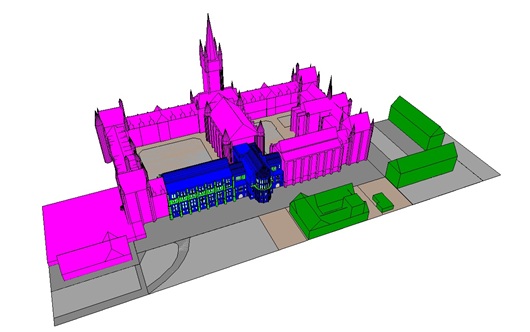
My Civil Engineering PhD seeks to digitally replicate a portion of the Gilbert Scott Building, which I can then use to suggest methods to improve its current condition and performance, using Digital Twin Technology.
The selected portion incorporates the Hunterian Museum, and everything below its footprint, which includes the Hunter Halls, the Concert Hall and the University of Glasgow Gift Shop.
With the support of The Hunterian, a working relationship has established, and I have been lucky to benefit from unlimited access to the Museum and from staff knowledge and expertise.
What is a Digital Twin?
In an architectural context, a digital twin replicates a building’s operation by integrating the building geometry, thermal performance and energy systems, alongside real-time and historic data from meters and sensors.
Even the opening of windows is modelled across the museum in my digital twin, to reflect the impact of external temperatures on the internal environment.
The use of digital twins within the heritage context remains quite limited. Most studies focus on the modelling of internal environments, studying the effect of occupancy and humidity on building health and on any displayed artefacts present.


This study builds upon current research, by applying interventions such as operational changes, or upgrades to energy and thermal performance.
Operational changes could mean a refinement of the heating schedule, and thermal interventions can address areas of heat loss, such as windows and doors, or uninsulated cavities.
We can also assess whether the adaption of current energy systems is viable, and whether small renewable solutions could be implemented sensitively in the historic environment.
Through the modelling of these interventions on the digital twin, we can assess the impact of different combinations, and make an informed decision based on suitability, cost and energy-savings.
The importance of choosing solutions that are sensitive to the historic environment is paramount to the project, as conservation and sustainability must go hand-in-hand to ensure that historic buildings retain their celebrated architecture and features, whilst also being resilient.
Why Digitalisation Matters for Museums Today
Cultural institutions are under increasing pressure to adapt to the climate crisis, and improve their sustainability and accessibility.
A 2024 Buro Happold survey found that 40% of UK museum buildings have average or below average operational energy performance.
Many museums occupy notable historic buildings, which typically perform poorly due to inadequate insulation, inefficient heating systems and reliance on fossil fuels.
The Hunterian Museum sits within the Grade A–listed Gilbert Scott Building, meaning any retrofit must be carefully considered and must also pass through Listed Building Consent.

While this process prioritises preserving historic character, it offers limited guidance on sustainable or sensitive adaptation.
Digitalisation within museums takes many forms, but environmental monitoring remains central to protecting collections. Sensors tracking temperature, humidity, light and CO₂ ensure artefacts remain within acceptable conservation thresholds, while Building Management System (BMS) platforms provide insight into energy use and allow control over operational schedules such as heating.
Unfortunately, non-domestic historic buildings often rely on outdated management and monitoring systems, which can provide data that is incomplete, inconsistent or difficult to interpret.
As expectations grow for museums to provide transparent, accurate environmental and energy data, these legacy systems increasingly limit effective management.
Digital twin technologies offer a way to consolidate this information into a single, coherent platform, linking real‑time data to the physical systems and architectural context it represents.
In doing so, they transform scattered datasets into an integrated model capable of supporting analysis, optimisation and long‑term conservation planning.
Behind the Scenes: Discoveries at the Hunterian Museum
To gather an essential insight into the Gilbert Scott Building and its performance, a wide range of sources were consulted.
The University of Glasgow’s Archives and Special Collections provided architectural drawings and early documents related to the construction, such as minutes of planning meetings, and bills of quantities.


These documents allowed definition of materials used in the construction, such as the fire-proof ‘Fox and Barrat’ patent floor of the Hunterian Museum, which consists of historic lime concrete, poured in-situ around iron joists.
Thermal imaging was conducted in and around the studied portion of the building, highlighting areas of heat loss. The outdoor thermal imaging was conducted on a cold winter morning, where the heat was turned up to the max by the University Energy Team to see heat loss areas clearly.


In an effort to understand the layout of the modelled portion, I have been taken on tours by University staff, including the Museum and giftshop teams, engineers and the Music Department. Secret spaces such as unmapped rooms and tunnels below the building were revealed.
The largest tunnels spans from the North Range to South under the cloisters, and is home to the university’s heat network distribution system, alongside an old telephone exchange and storage for examination tables.
When attempting to understand and map the extensive and spaghetti-like electricity switchboards, we stumbled across pieces of the past, such as electrical distribution to a large incinerator, which was used by anatomy students in previous centuries.

The Hunterian Museum uses discreet sensors within displays and in rooms to monitor temperature and humidity, providing essential insight into environmental conditions.
Because of the building’s age and construction, internal conditions are strongly influenced by external weather, meaning temperature and humidity can fall outside of desired limits, with implications for both artefact conservation and building health.
The collected data has already revealed how occupancy, indoor conditions and outdoor climate interact within the museum. We are now developing additional sensors to monitor CO2, humidity and temperature across the museum and other historic environments on the University of Glasgow campus.
My PhD experience so far has been enlightening. I have used my skills in digital modelling, engineering, architecture and policy to create a project that I’m truly passionate about.
I have had the pleasure of meeting like-minded people from The Hunterian and the University of Glasgow’s Estates team, who have been more than willing to share their knowledge and expertise with me.
What this Means for Historic Buildings and Society
I believe that incorporating digital twin technology into the historic environment at this present time is very important.
If the UK Government plan to meet net zero by 2045, significant pressure will be placed on all historic buildings to rapidly adapt and achieve better energy performance.
Digital twin technology can allow us to trial climate adaption strategies on historic archetypes whilst navigating strict policy designations, cost and viability.
By embedding these tools now, we can build the evidence base and digital infrastructure needed to guide future retrofit decisions and support the long‑term resilience of the historic estate.
The Hunterian Museum is more than its exhibits – it’s a living system. Digital twin technology reveals how we can make it more energy efficient, more sustainable, while still true to its historic character.
Visit the Hunterian Museum and experience the building Catherine has been mapping. As you explore, you’ll see the architecture, collections, and hidden systems working together.
Thanks to National Lottery players, we are currently carrying out a crucial scoping project that will shape the future of our public-facing venues on the University of Glasgow campus, the Hunterian Museum and Hunterian Art Gallery. Find out more.
Stay up to date with all the latest news and stories from The Hunterian via our blog, or our website.
