
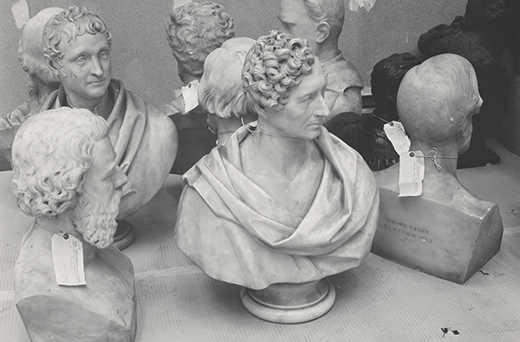
In this long-read post, Harriet Gaston explores the development and transformation of the Hunterian Art Gallery at the University of Glasgow, from its modest beginnings as the private collection of an 18th-century physician, to one of Scotland’s leading cultural attractions.
The Hunterian at the University of Glasgow opened its doors in 1807, making it Scotland’s oldest public museum, and the first in Britain with a gallery of paintings.
Best known today for its internationally significant Whistler and Mackintosh collections, the Hunterian Art Gallery has evolved from the personal collection of Dr William Hunter to one of the most distinguished public art collections in Scotland.
Hunter was a highly successful Scottish anatomist, obstetrician and teacher whose wealth was accumulated in the 18th century, at a time shaped by colonial expansion and the exploitation of enslaved people.
The Hunterian is built on his vast collections which he left to the University of Glasgow in 1783, along with funds to build a museum to house them.

Origins and Early Holdings
Hunter valued art, not only as decoration but as a tool for teaching. He believed visual representation was essential to understanding and saw his collection as a working intellectual resource.
By the time of his death, Hunter had assembled over 40,000 items, including books and manuscripts, coins and medals and anatomical preparations. His art collection was relatively small in comparison, but was selected with purpose, featuring works by artists such as Chardin, Rembrandt and Koninck.
He was acquainted with the leading artists of his day, including Sir Joshua Reynolds, Allan Ramsay and George Stubbs, and as Professor of Anatomy at the Royal Academy of Arts, Hunter taught painters and sculptors to accurately capture the human form.
The inclusion of Hunter’s paintings in his will, alongside his coins, books and specimens, reinforces the close connection he saw between art and science, and that he saw them as an essential part of the legacy he intended for Glasgow.
Britain’s First Public Art Gallery
The original Hunterian Museum opened in 1807 near Glasgow Cathedral, housed in a neoclassical building designed by the architect William Stark. The museum included a picture gallery which was the first dedicated display of Hunter’s art collection.
The picture gallery was the centrepiece of the museum and one of Britain’s earliest public art displays. On the upper floor, beneath a central dome, the paintings were hung densely in the style of the period. It soon became a major cultural attraction, popular with locals and visitors to the city, who praised the architecture, light and atmosphere.
As the collections continued to grow, the rooms became increasingly crowded. From descriptions of the time, we know the spaces were packed with exhibits, often with cases from floor to ceiling. By the mid‑19th century, the building itself had begun to deteriorate, due to the industrial pollution that consumed the site, becoming overcrowded and environmentally unstable.
When the University moved west to Gilmorehill in 1870, the Hunterian Museum went with it.


Left – The first Hunterian Museum. Right – The Picture Gallery, 1870. © T & R Annan & Sons.
The Move to Gilmorehill
Moving the extensive collections to the West End of Glasgow was a major logistical operation, but, remarkably, it was carried out without incident. The Hunterian Museum was given a prime position in the University’s impressive new main building, and the collections were arranged across three large halls.
This time there was no dedicated gallery space, so the artworks were interspersed with other items in the Library and Central Hall (now the Kelvin Gallery and Entrance Hall). Larger paintings were hung on the walls with smaller works shown in frames on top of table cases.
As the art collections expanded, they were spread across other University spaces, highlighting the need for a more permanent solution. Over the following decades, bequests and acquisitions helped broaden The Hunterian’s holdings, making the case for a purpose-built art gallery even more compelling.
A turning point came in 1935, when the sister-in-law of American artist James McNeill Whistler made an extraordinary donation to the University of Glasgow.


Left and Right – The Central Hall of the Hunterian Museum on Gilmorehill, 1891. © T & R Annan & Sons.
The Birnie Philip Bequest
Although Whistler never visited Glasgow, he did have Scottish ancestry and links to the city through the Glasgow Boys and other artists and collectors. His portrait of Scottish historian Thomas Carlyle was the first of his works to enter a public collection when it was purchased by the Glasgow Corporation in 1891.
The University of Glasgow awarded Whistler an honorary degree in 1903, making him a Doctor of Laws. This recognition was the catalyst for the major gift that transformed The Hunterian’s art collection.
In 1935, Whistler’s sister-in-law and heir, Rosalind Birnie Philip, presented the University with the contents of the artist’s estate, which included paintings, prints, drawings, watercolours, pastels, manuscripts, artist’s materials, furniture and collections of silver and ceramics.
Her subsequent gifts in 1954 and 1958 cemented the Whistler collection as one of the best in the world and established the University’s reputation as a global hub for Whistler studies. It also further highlighted the need for a dedicated art gallery.

20th-Century Expansion
By the 1950s, The Hunterian’s art holdings had grown from a few hundred works to over 10,000 thanks to further generous donations and bequests.
Many gifts supported the teaching of art history, and one of the most significant was Dr James McCallum’s donation of around 4,000 prints from 1939 onwards. He later followed this with an additional bequest and an endowment for future purchases. Combined with the 1940 bequest of Professor WR Scott, this formed the nucleus of The Hunterian print collection – now one of Scotland’s largest, spanning major European printmakers from the Renaissance to the present day.
The Mackintosh collection was established in 1946 through the acquisition of furniture from the Glasgow home of Charles Rennie Mackintosh and Margaret Macdonald Mackintosh, gifted by Hamish and Cameron Davidson. The following year, the Mackintoshes’ heir, Sylvan McNair, donated around 600 drawings, watercolours and designs, securing The Hunterian’s position as the leading collection of the Mackintoshes’ work.
Ina Smillie’s 1963 gift of 29 Old Master paintings, including works by Hans Horions and Edwaert Collier, further strengthened the holdings and in 1965, Dr Leonard Gow presented a comprehensive collection of prints by Muirhead Bone.
By the 1970s, the collections had outgrown the Hunterian Museum, reflecting more than half a century of sustained growth. During this decade, William Cargill presented works by Sir Joshua Reynolds and Allan Ramsay, while Gilbert Innes donated paintings by leading modern Scottish artists such as Fergusson, Peploe, Hornel and Cadell.


Left and Right – The Whistler and Macfie Collections in the Hunterian Art Gallery, c.1980.
Dr Charles Hepburn bequeathed a group of 18th-century portraits, including works by Sir Henry Raeburn, and Professor Alec Macfie made several important gifts, notably a substantial collection by artists such as Joan Eardley, Anne Redpath and Mary Armour.
Thanks to donors such as Gilbert Innes, Alec Macfie and George Smith – who donated much of his collection in the 1990s – The Hunterian is now home to one of the world’s best collections of works by the Glasgow Boys and the Scottish Colourists. More recently, gifts and bequests from Margaret and Winifred Davidson, daughters of the aforementioned Hamish Davidson, have enhanced The Hunterian’s collection of late 19th- and early 20th-century Scottish art.
Building a Dedicated Gallery
Plans for a dedicated art gallery finally came to fruition during the 1970s, thanks to the efforts of Andrew McLaren Young. As the University’s Richmond Professor of History of Art, he played a crucial role in advocating for a purpose-built solution, raising the profile of the art collections through exhibitions and publications.
Despite spiralling inflation and cuts to University budgets, work on a new gallery finally began in 1973, on a site beside the new University Library.


Left and Right – Construction of the Hunterian Art Gallery in the 1970s.
Financial uncertainties threatened the project and, controversially, the University considered the sale of several works from the Whistler collection to fund the completion of the building. Following public outcry and a major fundraising campaign, sufficient support was secured to complete the project.
Initially called ‘The Hunterian Museum Extension for Fine Art’, the new structure was officially named the ‘Hunterian Art Gallery’, and opened in two phases, in 1980 and 1981.
The brutalist design by architects William Whitfield and Partners featured distinctive bush‑hammered concrete, a round tower, a sculpture courtyard, and signature cast aluminium doors created by Scottish artist Eduardo Paolozzi.


Left – The Hunterian Art Gallery, c.1980. Right – View of an empty Gallery 1 through the Paolozzi Doors.
Recreating the Mackintosh House
One of the most unusual features of the new Hunterian Art Gallery was the inclusion of the Mackintosh House as an integral part of the building. The interiors were reconstructed within the second phase of the gallery, which opened in 1981.
From 1906 until 1914, artists Charles Rennie Mackintosh and Margaret Macdonald Mackintosh lived just one street away from the gallery’s present site. The mid-19th century house at 78 Southpark Avenue (originally 6 Florentine Terrace) was remodelled by the Mackintoshes, creating a distinctive home that showcased their design skills.
When the University campus expanded in the 1960s, the house was demolished but the surviving interiors and fittings were carefully preserved and rebuilt within the Hunterian Art Gallery.


Left – The principal bedroom of the Mackintosh House under construction.
Right – The external façade with the ‘floating door’.
The reconstructed rooms included the hallway, dining room, studio, drawing room and principal bedroom. Thanks to its position some 100 metres away from the original house, the Mackintosh House enjoys virtually the same views and effects of natural light.
The external façade with its famous ‘floating door’ is suspended above ground level, deliberately echoing the appearance of a 19th‑century terraced house within the concrete brutalist building, which has been described as an architectural enigma.
The Mackintosh House has become one of The Hunterian’s best-known attractions, and an important part of Glasgow’s presentation of the Mackintoshes’ artistic legacy.
The Hunterian Art Gallery Today
The opening of the dedicated, modern gallery finally gave the art collection a permanent home, marking the culmination of a journey that began with William Hunter’s private collection over 200 years ago.
From modest beginnings to international recognition, the gallery embodies the University’s commitment to preserving and sharing artistic heritage, fulfilling Hunter’s vision of art as a tool for learning that is open to all.
Today, the Hunterian Art Gallery is a cornerstone of Scotland’s cultural landscape, engaging audiences through major exhibitions and online resources while supporting teaching, learning and research.
It is best known for its internationally significant Whistler and Mackintosh collections, but the holdings span a remarkable range of works, from Rubens and Rembrandt to the Scottish Colourists and Glasgow Boys. It also features important works by leading contemporary artists.

The Hunterian is also recognised for its thoughtful and often critically engaged approach to curation, exploring themes such as colonial history, gender in art, and the work of historically underrepresented artists.
In many ways, The Hunterian has come full circle. As it continues to open up its collections and support new research, it is also laying the foundations for a legacy that will endure for generations to come.
The Next Chapter: Unlocking the Potential of The Hunterian
The Hunterian’s story is far from over. Thanks to National Lottery players and support from The National Lottery Heritage Fund, we have begun a crucial redevelopment scoping project: ‘Unlocking the Potential of The Hunterian: The Changing Museum.’
This project is made possible by funding from The National Lottery Heritage Fund, which supports initiatives that connect people and communities with the UK’s heritage. Thanks to National Lottery players, we can now take the first steps toward shaping the future of The Hunterian’s public-facing venues on the University of Glasgow campus.
The scoping project will allow us to fully understand what is needed to reimagine and safeguard the Hunterian Museum and Hunterian Art Gallery for future generations. It will explore how we can create spaces that are more accessible, engaging, and inspiring — while preserving the integrity of Hunter’s collections.
This is not just about buildings; it’s about unlocking the potential of The Hunterian as a cultural and educational resource for all.
Stay up to date with all the latest news and stories from The Hunterian via our blog, or our website.
